



loading
| Availability: | |
|---|---|
| Quantity: | |


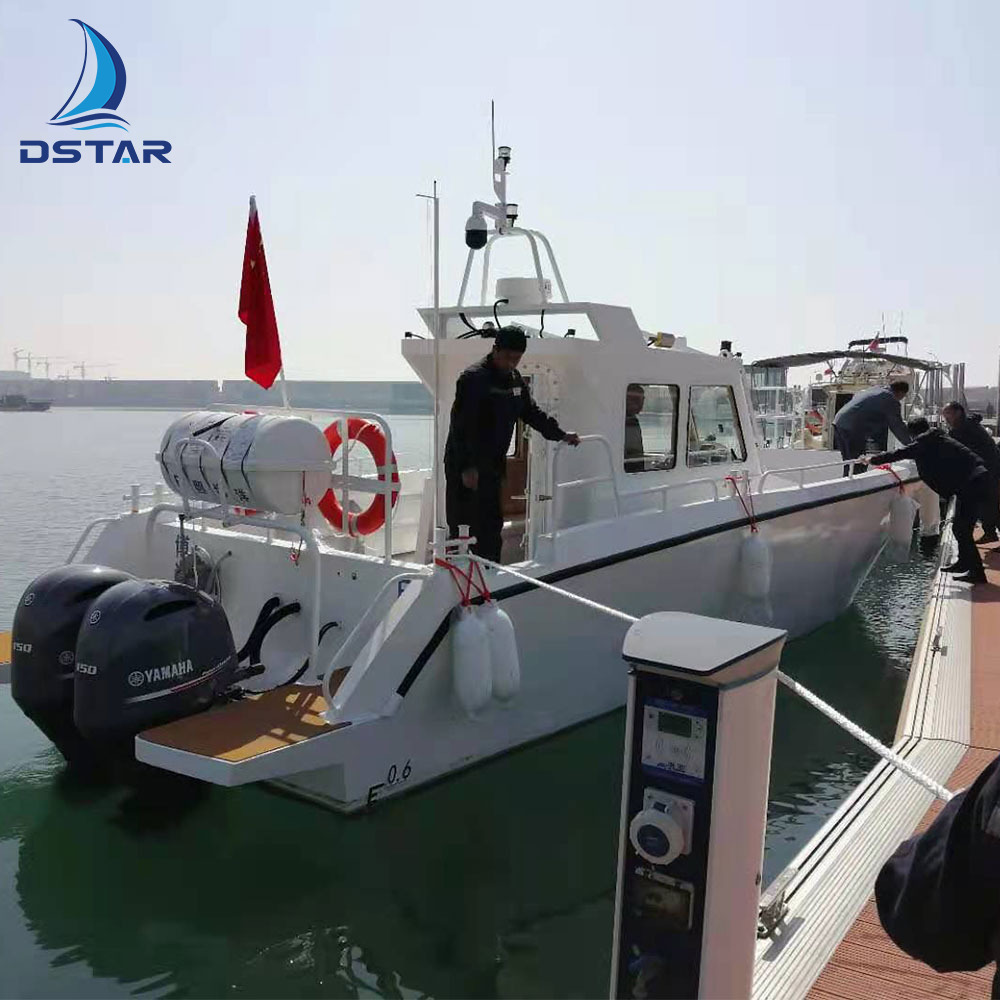
The Dookyu Crown 11m Aluminum Coastal Utility and Fishing Support Boat is a working platform specified for near-shore operations where a leisure layout would be a liability. This hull is positioned for three jobs: supporting small-scale coastal fisheries, moving stores and equipment between a mainland harbour and nearby islands, and carrying survey or dive teams into shallow, awkward water. The boat is a Dookyu Crown build in marine-grade aluminium alloy, built to order with a layout agreed at contract stage. Because the platform is configured around work rather than around passenger comfort, the deck is kept open, the load paths are kept short, and the systems are chosen for serviceability in a small yard rather than for showroom appeal. Published figures in the parameter table are listed data for the standard arrangement. They describe the baseline configuration and are the reference point for a project-specific discussion, not a guarantee of measured performance in every loading condition.
This model is deliberately separated from the yard's 11m leisure cruising boat. The cruising boat is specified for day trips, seating and accommodation; this boat is specified for cargo, working deck space and support roles. A buyer who wants a coastal cruiser with a social cockpit and a cabin for overnight stops should be directed to the cruising model. A buyer who needs a load deck, a working transom and space for survey or dive equipment is the correct audience here.
Keeping the two roles apart matters commercially as well as technically. The deck arrangement, the structural allowance for point loads, the tankage and the equipment schedule all differ. Owners arrive with three recurring operating patterns. The first is a near-shore fishery support role, running gear and catch between grounds, landing points and a buyer on the same island group. The second is harbour and island logistics, moving fuel drums, water, spares, building materials and personnel on a schedule. The third is survey and dive support, holding position over a site while a team works. Each pattern sets a different priority on deck area, reserve buoyancy, fuel range and crew shelter, and each is resolved at specification stage.
The hull is a single-skin aluminium alloy structure with transverse framing, welded to a flush working deck. The arrangement is intentionally simple. Aft, the transom is left clear so that a dive ladder, a boarding platform or a small lifting arrangement can be fitted per project. The working deck runs forward to the console or wheelhouse position, with the gunwale height set to give a firm knee-and-thigh support while allowing an adult to reach over the side for line handling.
Under-deck space is used for tankage, battery stowage and a dry locker, and access hatches are sized so that a technician can reach fuel senders, bilge pump strainers and wiring runs without dismantling the deck. Forward, the sheer rises to give reserve buoyancy and a drier ride when the boat is running into a short chop. The deck is finished with a non-slip coating rather than a decorative floor covering, because the working surface will be wet, oily and loaded.
Load distribution is the operator's responsibility. Heavy items belong low and near the centre of flotation, and any fixed item such as a winch, davit or survey frame is a project-specific addition that requires a structural review before fitment. Handrails, toe rails and freeing port arrangement are agreed with the layout, because a fishing deck, a cargo deck and a dive deck each want a different compromise between retention of gear and rapid water clearance.
The listed baseline is twin 150HP (110kW) outboard main engines with 400L of fuel capacity. Twin engines are chosen for workboat practicality: redundancy at sea, close-quarters handling in a harbour, and the ability to hold a position over a dive or survey site. The design speed shown in the table is 26kn. That figure is listed data for the baseline configuration against the standard load condition; achieved speed will vary with total displacement, propeller selection, sea state, hull fouling, air temperature and the amount of deck cargo carried. Loaded for a resupply run, the boat will not hold the light-condition figure, and no speed should be promised to a client as a contractual outcome.
Fuel endurance depends on the same variables and on how the boat is driven, so range planning should be done from the actual duty cycle with a reserve for weather and holding. Engine choice, gear ratio and propeller are matched to the duty: a boat that spends its life at displacement speed with heavy loads is specified differently from one that runs light and fast between islands. Instrumentation, engine monitoring, auxiliary charging and fuel polishing are quoted as optional items per project, and the electrical capacity is sized around the equipment actually selected rather than around a nominal allowance.
Every fit-out item on this boat is project-specific or optional. Nothing described below should be read as a fixed standard package.
For fishery support, the usual request is a pair of working winches, a net or pot handling arrangement, insulated fish boxes secured to the deck, and a wash-down pump fed from a dedicated tank. For island logistics, the priorities are a larger clear deck area, tie-down points at known intervals, a simple cargo boom or an A-frame at the transom, and protective fendering so the boat can lie alongside a rough concrete jetty without damaging topsides or rub rail.
For survey and dive support, the request usually includes a transom dive ladder, a cylinder rack, a compressor or gas blending stowage position, a bench for instrument preparation, a 12V and 24V distribution board with spare ways, and a mounting pad for a survey transducer. Electronics are quoted as an optional package and are not supplied as standard. A VHF set, a GNSS position source, a sounder and a navigation light set are selected by the operator to suit the flag state and the intended area of operation.
Life-saving equipment, fire-fighting equipment and any certification-related item are supplied against the project requirement and the applicable administration's rules, not against a fixed list. Where an owner intends to register the boat or submit it for survey, the equipment schedule should be drawn up with the chosen administration or surveyor in the room, because a configuration agreed without reference to those rules is frequently reworked later at the owner's cost.
The hull is built from marine-grade aluminium alloy selected for its strength-to-weight ratio and its behaviour in a saltwater working environment. Welding is carried out to a written procedure, and the build record - material certificates, weld records and, where required, non-destructive testing results - is compiled as the boat is assembled rather than reconstructed afterwards. That record matters later: an owner preparing for a survey, an insurance inspection or a registration application will be asked for it.
Corrosion protection is planned as a system, not a coat of paint. The underwater body receives a compatible primer and anti-fouling scheme, and the hull is fitted with anodes sized to the boat and to the local water. Above the waterline, the alloy is left as a working finish or coated to the owner's specification. Dissimilar metals are isolated at every fixing point, because a stainless fastener in an aluminium deck is the most common cause of premature corrosion on a boat of this type.
Maintenance is scheduled around the duty cycle: anodes checked at each slipping, fastenings and welds inspected annually, engine service intervals set by the manufacturer, fuel filters changed on hours rather than on optimism, and the electrical installation inspected for chafed runs and corroded terminals. Because the layout is open, inspection access is good, and most routine work can be done alongside a quay rather than in a shed. A maintenance log started at delivery pays for itself at the first resale survey.
The table below lists the published baseline data for this model. Values describe the standard arrangement. They are listed data, not a performance guarantee, and any deviation agreed at contract stage is reflected in the project documentation.
Parameter | Listed data |
|---|---|
Overall length LOA | 11.00m |
Length L | 8.81m |
Beam B | 3.25m |
Depth D | 0.885m |
Full-load draft | 0.47m |
Full-load displacement | 5.60t |
Design speed (listed data) | 26kn |
Main engine | 150HP (110kW) x 2 |
Fuel capacity | 400L |
Near-shore fishery support: gear, catch and crew transfer within an island group or along a coastal strip.
Harbour and island logistics: water, fuel in drums, spares, building materials and personnel.
Survey support: holding station, instrument deployment and recovery, and a protected working bench.
Dive support: cylinder stowage, ladder access and a clear transom working area.
Coastal maintenance contracts: tools, small plant and a two- or three-person crew to a site.
Aquaculture service: feeding, net inspection, mooring work and routine site transfers.
The boat is not offered for long-range offshore passage, overnight passenger carriage or any duty outside the area and conditions agreed for the project.
Q1: Is this the same boat as your 11m leisure cruising model?
A: No. This is a working platform with an open load deck, specified for fishery support, island logistics and survey or dive work. The leisure cruiser is a separate model with a social cockpit and accommodation. If the requirement is day trips and overnight stays, the cruising model is the correct starting point.
Q2: Can the deck layout be changed?
A: Yes, within structural limits. Winches, davits, A-frames, dive ladders, benches and tie-down patterns are project-specific additions. Any item that applies a concentrated load to the deck or the framing is reviewed before it is fitted.
Q3: What speed will the boat actually achieve?
A: The table lists 26kn as design data for the baseline arrangement. Real speed depends on displacement, propeller, sea state, hull condition and deck load. A target is quoted and confirmed against the agreed configuration; a speed figure is not guaranteed as an outcome.
Q4: Is navigation and safety equipment included as standard?
A: Electronics, life-saving equipment and fire-fighting equipment are quoted as an optional package matched to the flag state and the operating area. They are not a fixed standard fit, and the final schedule is agreed project by project.
Q5: Does the yard supply certification with the boat?
A: The yard builds, documents and prepares the boat for survey. Certification is issued by the administration or class society the owner selects, after that body has reviewed the design and the build and completed its own inspection. The yard supports that process with drawings, material and weld records and test documentation; the certificate itself is not issued by the yard and is not guaranteed by it.
Q6: How is the boat maintained in service?
A: Anodes are checked at each slipping, welds and fastenings inspected annually, engines serviced to the manufacturer intervals, and the electrical installation inspected for chafing and corrosion. The open layout gives good access for routine work alongside a quay.


