

Views: 0 Author: Site Editor Publish Time: 2026-09-09 Origin: Site


The shift in blue-water cruising is undeniable today. Sailors are moving rapidly away from traditional monohulls toward expedition-grade catamarans. Explorers now demand incredible stability and vast space for extreme ocean passages. While production fiberglass vessels currently dominate the charter market, serious circumnavigators face entirely different realities. High-latitude explorers are increasingly evaluating aluminum for its unmatched structural integrity. We offer an objective, decision-stage breakdown of why you might need such a specialized vessel. You will discover the engineering trade-offs involved in material selection and system design. Finally, we explore exactly how you should evaluate builders before committing to a multi-million-dollar custom project.
Impact Survivability: Aluminum hulls deform rather than shatter upon impact with submerged objects or ice, offering unmatched safety for remote blue-water cruising.
Bespoke Capabilities: Unlike fiberglass builds constrained by expensive molds, aluminum allows for true customization, making it the preferred material for a custom luxury catamaran yacht.
Crucial Trade-offs: The advantages of aluminum come with strict maintenance requirements—specifically, managing galvanic corrosion and ensuring meticulous electrical isolation.
Lifecycle ROI: While initial build costs and lead times are higher, unpainted aluminum hulls offer lower long-term exterior maintenance costs and exceptionally high resale value in the explorer niche.
We must first frame the problem standard production models face globally. Standard production catamarans often lack the extensive payload capacity required for serious exploration. You cannot safely beach them on remote, rocky shores. They also struggle against heavy impacts during debris-heavy ocean crossings. Production composite hulls rely on stiff, brittle materials. When a fiberglass hull strikes a semi-submerged shipping container at ten knots, it typically punctures or shatters.
The solution lies deeply in the physics of marine-grade 5000-series aluminum. This material fundamentally changes your safety margins at sea. We look specifically at its high tensile strength-to-weight ratio. Alloys like 5083 marine aluminum possess incredible elasticity. They absorb immense kinetic energy upon heavy impact without experiencing catastrophic failure. Instead of cracking, an aluminum plate will dent or deform. This localized deformation keeps the hull watertight, allowing you to reach a safe harbor safely.
Let us define the specific success criteria for choosing an Aluminum Catamaran Boat over standard options. You must weigh your actual cruising intentions carefully.
Prolonged Autonomy: You plan to stay entirely off-grid for months at a time, requiring massive storage.
Navigating Poorly Charted Waters: You frequently explore remote Pacific atolls full of uncharted coral heads.
Ice-Fringe Sailing: Your itinerary includes high-latitude regions prone to floating ice and aggressive growlers.
Conversely, aluminum engineering becomes excessive if you primarily enjoy coastal hopping. It is also completely unnecessary for typical Mediterranean summer chartering. In those environments, standard fiberglass models serve perfectly well.
People often assume aluminum is far too heavy for multihulls. This misconception ignores modern advancements in naval architecture. Designers optimize plate thickness precisely across the entire hull to maintain excellent sailing performance. They use thicker plates below the waterline for impact resistance. They use thinner plates topside to save crucial weight. An aluminum hull will rarely match the extreme lightness of advanced carbon fiber. However, a properly designed metal multihull performs admirably against heavily loaded production fiberglass cruisers.
Repairability presents another massive advantage for global explorers. Imagine damaging your hull heavily in a remote location. Sourcing specialized composite resins, core materials, and hardeners locally is extremely difficult. In stark contrast, TIG and MIG welding equipment is available almost globally. Local metalworkers in remote fishing villages can quickly patch a damaged metal plate. They weld a new piece over the dent, and you can resume your voyage.
We must also address thermal and acoustic insulation honestly. The implementation reality of metal hulls requires serious attention. Bare aluminum conducts both heat and noise very efficiently. Condensation will rain down inside a poorly insulated metal vessel. To combat this physical reality, builders must implement rigorous insulation strategies throughout the hull.
Spray or glue high-density closed-cell foam insulation directly to the inner hull plating.
Eliminate all internal air gaps between the foam and the metal to stop condensation forming.
Extend this premium insulation (such as Armacell) well below the waterline.
Apply thick acoustic dampening materials around engine rooms and mechanical spaces.
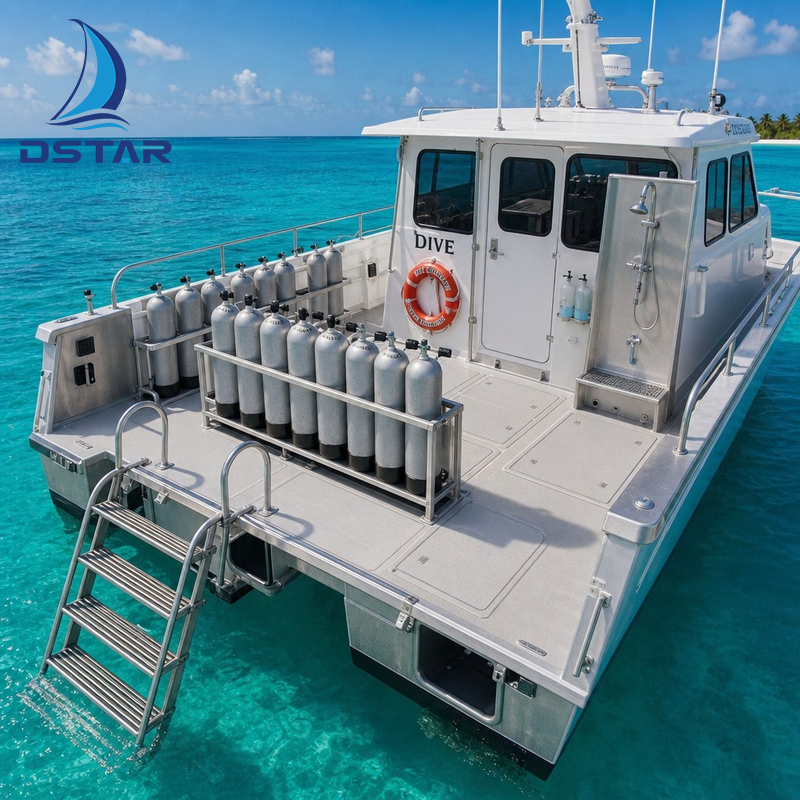
The absence of large fiberglass molds provides a distinct customization edge. Molds strictly dictate the exact shape, beam, and layout of production boats. Changing a bulkhead location in a molded boat requires re-engineering the entire internal grid. Aluminum fabrication completely removes this expensive constraint. Buyers can dictate exact watertight bulkhead placements. You can extend transom hulls for better buoyancy. You can completely reimagine interior spatial layouts.
This immense architectural freedom makes aluminum the preferred choice when commissioning a luxury catamaran yacht. Premium shipyards seamlessly integrate expedition-level exteriors alongside highly refined interiors. You get rugged, unpainted hulls and heavy-duty rub rails on the outside. Inside, you enjoy superyacht-level comfort. Builders use floating floors to eliminate vibration. They install bespoke cabinetry, premium stonework, and climate-controlled wine cellars.
Payload scalability further defines this structural advantage. True expedition sailing requires heavy, autonomous systems. You need massive solar arrays mounted on sturdy biminis. You require substantial lithium battery banks to run air conditioning off-grid. High-capacity watermakers and heavy dive compressors add significant weight. Aluminum framing supports this complex integration easily. It carries the weight of these systems without compromising structural integrity or long-term sailing dynamics.
You must manage galvanic corrosion meticulously. This remains the absolute biggest risk associated with metal vessel ownership. Galvanic corrosion occurs whenever dissimilar metals interact within a saltwater electrolyte. We must transparently address this serious threat. Proper engineering completely mitigates the risk, but negligence will destroy a hull quickly.
Prevention requires mandatory isolation transformers for all shore power connections. This stops stray currents from nearby marina vessels from eating your hull. Builders must use strict bipolar wiring systems. This establishes completely floating electrical grounds, keeping the hull out of the electrical circuit. Furthermore, you must strictly avoid any dissimilar metal contact below the waterline. Never apply copper-based antifouling paints on an aluminum hull. You must use specialized, copper-free bottom paints exclusively.
Next, consider your exterior hull finishes. We see a rapidly rising trend toward leaving topsides entirely unpainted. Bare aluminum quickly oxidizes. It develops a dull, gray, protective oxide layer naturally. This creates a rugged, low-maintenance aesthetic that serious sailors love. In contrast, fairing and painting an aluminum hull costs a massive premium. It requires layers of epoxy filler to hide weld seams. It also requires constant upkeep to maintain a high-gloss finish against fender scratches.
Table 1: Comparison of Exterior Finishing Strategies for Aluminum Hulls
| Feature | Unpainted (Bare Aluminum) | Faired and Painted |
|---|---|---|
| Initial Application Cost | Very Low (Acid wash and protective clear coat optional) | Extremely High (Extensive labor for filling, sanding, and painting) |
| Aesthetic Appearance | Rugged, industrial, dull gray finish | Superyacht-level high-gloss, smooth finish |
| Long-term Maintenance | Minimal (Rinse with fresh water, brush off salt) | High (Requires touch-ups for scratches and eventual repainting) |
| Damage Visibility | Scratches blend into the natural oxide layer | Scratches highly visible; exposes contrasting metal underneath |
Finally, you must evaluate lifecycle realities over a twenty-year horizon. We fully acknowledge the premium upfront cost of custom metal fabrication. However, this offsets the elimination of common fiberglass issues. You never worry about hull osmosis blistering. You avoid structural gelcoat UV degradation entirely. The longevity of the material makes the initial investment highly worthwhile for dedicated explorers.
Selecting the right builder ultimately guarantees project success. Buyers must verify the shipyard's specific design expertise. Ensure they partner actively with naval architects who specialize exclusively in aluminum multihulls. Designing a metal monohull requires entirely different math. Designing a composite catamaran utilizes different structural assumptions. You need professionals who understand multihull righting moments applied specifically to welded structures.
You must scrutinize welding standards and certifications closely. Look for strict compliance within their technical documentation. Key benchmarks include ISO 12215 structural compliance and CE Category A certification. Electrical systems must meet rigorous ABYC standards to ensure safety. Furthermore, demand non-destructive testing during the build. High-quality yards routinely perform X-ray or ultrasound weld inspections. These tests prove structural integrity deep inside the joints.
Project management dictates the entire build experience. Assess the yard's financial stability before signing any contracts. Evaluate their communication transparency. Building a bespoke vessel involves an 18 to 36-month build cycle. You need a project manager who provides weekly photographic updates and clear milestone tracking. Finally, define their post-delivery warranty support clearly. Remote cruising demands reliable, responsive factory backing when complex systems inevitably need troubleshooting.
An aluminum multihull is never a mass-market vessel. It operates instead as a purpose-built tool designed for uncompromising global exploration. It prioritizes absolute safety, payload scalability, and structural resilience over cheap manufacturing.
Follow these actionable next steps to begin your journey:
Outline your exact cruising itinerary to identify your true structural requirements.
Consult a specialized naval architect to calculate your exact payload and autonomy demands.
Begin vetting specialized shipyards by requesting verifiable, expedition-grade portfolios.
Hire an independent marine surveyor to oversee the build process and monitor welding standards.
A: It is slightly heavier than performance composites. However, it remains highly comparable to loaded production fiberglass cruisers. Overall speed depends heavily on hull design, waterline length, and strict payload discipline by the owner.
A: You must use sacrificial zinc or aluminum anodes. Always install isolation transformers for shore power connections. You need dual-pole electrical systems to isolate all grounds. Finally, strictly apply non-copper antifouling paint.
A: The material does not rely on expensive mass-production molds. This flexibility makes it economically viable for one-off builds. Shipyards can tailor every structural element to meet specific owner requirements perfectly.
A: Yes. The exterior often maintains a rugged and utilitarian appearance. However, builders frequently outfit the interiors to superyacht standards. This makes the luxury catamaran yacht concept fully realizable in expedition-grade aluminum.


