

Views: 0 Author: Site Editor Publish Time: 2026-10-28 Origin: Site


The marine industry is undergoing a massive shift. Monohulls are stepping aside, and multihull designs are rapidly taking over. Recent market analyses project a sharp spike in demand for commercial and private vessels that prioritize fuel efficiency, offshore stability, and maximum deck space. Driven by stricter maritime emissions standards and the constant need for higher payload capacities, fleet operators and private enthusiasts are abandoning outdated platforms. They want boats that adapt to unpredictable waters without inflating operational overhead.
When the hydrodynamic brilliance of a dual-hull configuration merges with the rugged structural integrity of marine-grade metal, the resulting watercraft stands in a league of its own. However, procuring such a vessel is a substantial capital investment. The current market is saturated with varying dimensions, complex propulsion systems, and highly specialized hull geometries. Without a rigorous and objective framework to evaluate these variables, buyers risk acquiring a boat that falls short of their operational demands or drains resources through excessive long-term maintenance.
This comprehensive guide is designed to dismantle the complexities of the procurement process. I have seen countless buyers make costly mistakes by choosing the wrong hull geometry or underestimating their payload needs. Whether you are sourcing a heavy-duty fleet platform for offshore logistics or designing a luxurious cruiser for weekend family excursions, the following insights will systematically direct you toward the ideal vessel tailored precisely to your maritime requirements.
Purpose Dictates Design: The engineering blueprint for a heavy-duty commercial vessel differs fundamentally from a recreational cruiser. Defining your exact daily use case is the mandatory first step.
Unmatched Stability: Dual-hull platforms provide a wider stance and a higher metacentric height. This translates to superior lateral balance, massive deck areas, and improved fuel economy compared to single-hull alternatives.
The Metal Advantage: High-tensile marine alloys, specifically the 5083 series, are exceptionally lightweight and highly resistant to saltwater corrosion. They demand a fraction of the structural maintenance required by traditional fiberglass.
Customization is Key: From weather-sealed pilothouses to precise outboard configurations, partnering with a manufacturer capable of engineering highly tailored solutions is critical to maximizing your long-term return on investment.
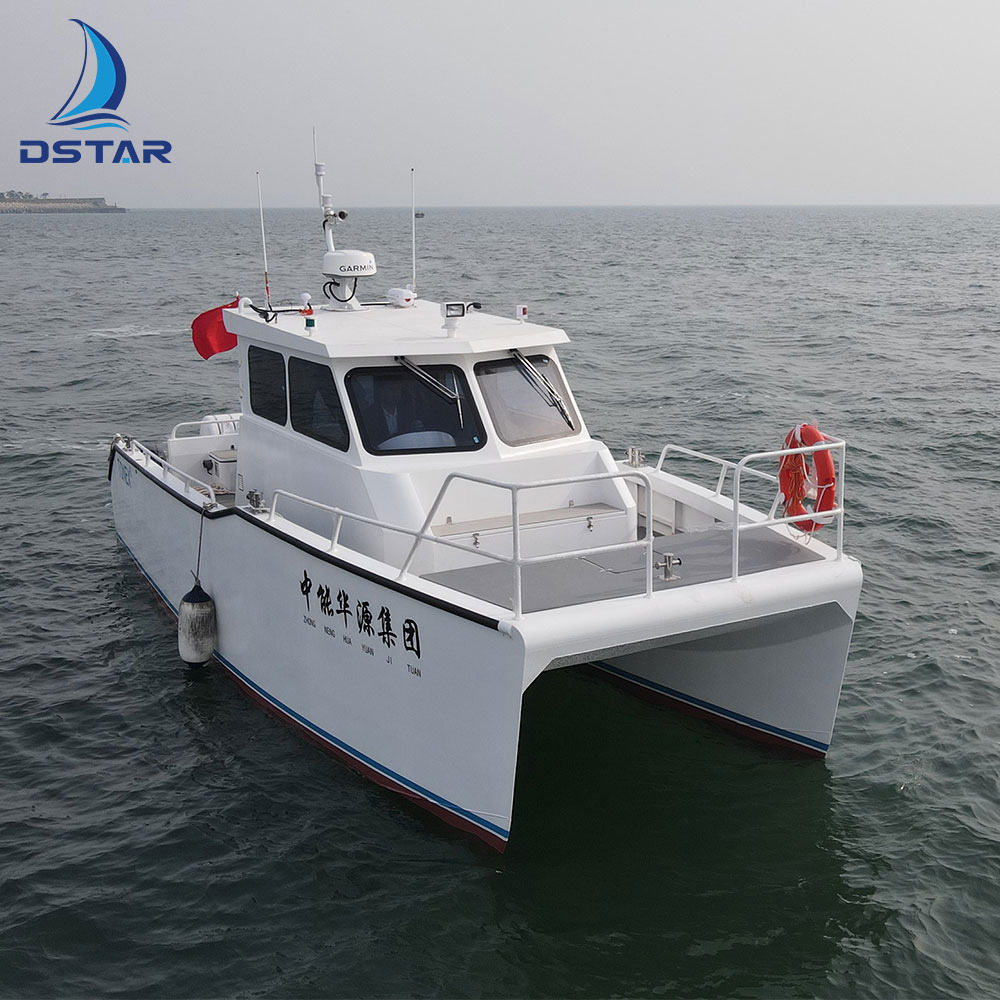
To truly grasp the long-term value of these vessels, we must look closely at the intersection of geometric design and material science. A catamaran relies on two parallel hulls of equal size connected by a rigid, elevated deck. Executing this design in metal yields a suite of operational benefits that composite materials simply cannot match.
Fiberglass shatters under sudden kinetic stress. Over years of hard use, composites are susceptible to gel coat blistering and deep structural osmosis. Marine-grade aluminum behaves entirely differently. Formulated specifically for punishing offshore environments, alloys packed with magnesium develop a natural, self-healing oxide layer. This chemical barrier actively repels deep structural corrosion, even in the harshest high-salinity conditions.
Furthermore, aluminum boasts incredible ductility. Picture your crew navigating a debris-filled harbor after a heavy storm. If the hull strikes a submerged log at cruising speed, the metal will dent rather than crack. Absorbing that impact energy dramatically reduces the risk of catastrophic hull breaches. It keeps your crew safe and minimizes costly dry-dock repairs.
By displacing buoyancy to the absolute outer edges of the watercraft, a twin-hull design effectively neutralizes the aggressive rolling motion inherent to rough seas. For frontline commercial crews pulling heavy nets or transferring offshore cargo, this unyielding stability creates a much safer, level working platform. It drastically reduces physical fatigue over a twelve-hour shift. Private passengers benefit equally. The steady ride eliminates the jarring motions that typically induce seasickness, transforming a turbulent offshore crossing into a remarkably smooth journey.
Because the individual demi-hulls are exceptionally narrow, they slice through the water with a significantly reduced hydrodynamic footprint. Less wetted surface area means less drag. Consequently, the vessel requires far less horsepower to break the grip of the water and achieve planing speeds. This leads to measurable, day-over-day fuel savings. The displaced buoyancy also results in a surprisingly shallow draft. Operators can confidently push into coastal flats, tidal estuaries, and shallow reef zones that would instantly ground a deeper monohull.
The most critical phase of the buying journey happens before you ever look at a spec sheet. You must conduct a strict and honest assessment of your daily operations. A boat built to haul heavy machinery will feel entirely out of place at a family sandbar gathering, just as a leisure cruiser will fail under the severe stresses of commercial towing.
For industrial operators, functionality and raw durability supersede aesthetics. A dedicated Aluminum Work Boat is engineered to act as a floating utility truck. These specific builds require reinforced internal transverse framing and thickened deck plating to support the concentrated weight of hydraulic cranes, aquaculture gear, or heavy cargo logistics. They prioritize open, unobstructed aft decks and heavy-duty towing bollards over passenger seating.
In contrast, maritime enforcement and search-and-rescue teams require specialized tactical platforms. These vessels prioritize rapid hole-shots, tight maneuverability, and survivability in extreme weather. They are typically outfitted with shock-mitigating seating to protect the spines of the crew during high-speed wave impacts, alongside reinforced gunwales designed to withstand aggressive boarding operations.
When shifting focus to the private sector, the priorities pivot toward passenger comfort, aesthetic flow, and versatile layouts. Families and recreational anglers need platforms that offer a dry ride and plenty of space to move around. For those operating primarily on calm inland lakes, protected bays, or gentle coastal waters, the focus is on maximizing usable square footage for socializing, sunbathing, and easy water access.
| Feature Focus | Commercial Fleet Application | Private / Leisure Application |
|---|---|---|
| Deck Layout | Open aft, reinforced plating, heavy cargo tie-downs | Modular seating, sun pads, extended swim platforms |
| Cabin Style | Enclosed, forward-leaning pilothouse, climate controlled | Center console or open walk-around cabin |
| Hull Thickness | 6mm to 8mm bottom plates for extreme impact resistance | 4mm to 5mm bottom plates for weight savings and speed |
| Propulsion | High-torque inboard diesels or heavy-duty commercial outboards | High-speed, fuel-efficient twin outboards |
Once your primary application is locked in, the evaluation moves to the technical metrics. As an engineer, I cannot stress enough how these numbers dictate whether the vessel will safely perform its intended duties or struggle against the elements.
Length overall and beam width directly dictate your operational limits. Take a standard 9.8m 32ft aluminum catamaran as a baseline. A vessel of this footprint typically offers a generous beam width of around 3 meters. This translates to nearly forty percent more usable deck space than a monohull of the exact same length. While a compact 20-foot multihull offers incredible agility for near-shore fishing, pushing into open ocean swells or transporting a dozen passengers requires stepping up to that 30-foot plus category to maintain safety margins.
Every hull has a strict maximum displacement limit that cannot be safely ignored. Buyers must calculate the wet weight of their operations. This includes the maximum number of passengers, fully topped-off fuel and water tanks, heavy dive tanks, and filled livewells. Commercial buyers must meticulously calculate deadweight tonnage to ensure cargo transport does not compromise the center of gravity. Overloading the hull presses the central tunnel too close to the waterline. This induces violent wave-slapping, drastically reduces speed, and compromises structural safety.
Choosing the right propulsion is a delicate balance between required top-end speed, fuel economy, and maintenance accessibility. Outboard motors remain the gold standard for vessels under 40 feet. For a 32ft setup, pairing twin 250 to 300 horsepower outboards provides an excellent power-to-weight ratio. They are easily trimmed up to clear shallow reef obstacles and can be swapped out quickly if major repairs are needed. Inboard diesel engines represent a larger initial capital expenditure, but they deliver the massive low-end torque required for heavy commercial towing.
The specific geometry of the individual demi-hulls dictates how the watercraft interacts with fluid dynamics. Educated buyers must navigate the distinction between the two primary configurations to align the boat with their handling expectations.
In a symmetrical setup, the port and starboard sides of each individual hull are perfect mirror images. This traditional design maximizes internal volume, generating immense buoyancy. Because they displace a massive amount of water evenly, symmetrical hulls excel at carrying heavy, unevenly distributed loads. They track exceptionally straight. This makes them the undisputed choice for heavy cargo transport, utility barges, and large passenger ferries where load-bearing stability is the ultimate goal.
Asymmetrical designs feature a relatively flat vertical surface on the inside facing the central tunnel, paired with a curved traditional shape on the outside. This unique geometry alters the hydrodynamic flow. It compresses air and water through the tunnel to generate lift while significantly reducing wave interference between the hulls. When banking into a turn, an asymmetrical hull leans inward much like a traditional V-hull, allowing for aggressive and tight cornering. This agile handling makes it the preferred foundation for an Aluminum Patrol Boat, rapid-response interceptors, and high-speed offshore sportfishing machines.
Unlike molded fiberglass boats, which are strictly limited by the expensive fixed tooling of their molds, metal fabrication offers unparalleled structural flexibility. You are not buying an off-the-shelf product; you are commissioning a tailored maritime tool.
The placement and style of the helm station dictate the entire workflow of the deck. A center console layout provides 360-degree walk-around access. Picture an angler fighting a pelagic fish from the bow to the stern without obstruction. This layout is vital for sportfishing and tactical boarding. Alternatively, commercial operators in the Pacific Northwest or North Sea require fully enclosed, forward-leaning pilothouses. These structures protect crews from freezing spray, reduce instrument glare, and house climate-controlled environments for exhausting shifts.
The deck should be a physical manifestation of your daily tasks. A commercial build might integrate flush-mounted heavy cargo tie-downs, reinforced push knees at the bow, and side-entry dive doors for swift water rescues. On the leisure side, a Catamaran Pontoon Boat configuration focuses on lifestyle enhancements. Think modular plush seating, integrated outdoor galleys, sprawling shaded canopies, and massive insulated fish boxes that double as secondary seating.
Modern maritime operations are heavily digitized. During the build phase, buyers must meticulously plan the electrical architecture of the vessel. Commercial operations require redundant battery banks to power high-definition radar arrays, deep-water sonar transducers, and Automatic Identification System transceivers. Planning these systems before the metal is cut ensures clean wiring routes, prevents electrical interference, and guarantees the helm console has the physical dashboard real estate to house large multi-function displays.
A responsible procurement strategy looks far beyond the initial sticker price. Bottom-of-funnel buyers must evaluate the total cost of ownership across a projected twenty-year operational lifecycle.
Financially speaking, precision-welded multihulls command a premium upfront. The cost of raw marine-grade metal, combined with the highly specialized tungsten and metal inert gas welding labor required, pushes the initial acquisition price higher than a mass-produced fiberglass monohull. However, the return on investment is undeniable. The aerodynamic efficiency of the twin hulls slashes annual fuel budgets. The structural longevity of the material ensures a significantly slower depreciation curve, resulting in exceptionally high resale values when it is time to upgrade the fleet.
Marine engineers celebrate aluminum for its low-maintenance profile. There is no gel coat to meticulously wax every season, and zero risk of hidden fiberglass rot. If a workboat sustains heavy damage against a concrete pier, a qualified marine welder simply cuts out the damaged plate and welds a new one in hours, drastically minimizing operational downtime. Your primary maintenance directive is galvanic corrosion prevention. Owners must strictly monitor and replace sacrificial zinc or aluminum anodes. Any anti-fouling bottom paint applied must be strictly copper-free, as copper reacts aggressively with submerged metal.
The ultimate safety and performance of your vessel rest entirely in the hands of the shipyard. Vetting potential builders is the final and non-negotiable step in the procurement journey.
Scrutinize the historical output of the builder. A shipyard that successfully delivers both rugged utilitarian workboats and highly refined luxury cruisers demonstrates a profound, versatile understanding of marine engineering. Do not hesitate to request case studies or direct references from previous clients who operate in similar aquatic environments to verify real-world performance.
Compliance with international maritime safety regulations is mandatory. Depending on your region, ensure the vessel is constructed to strict European CE Category B or C standards, ISO manufacturing protocols, or local commercial compliance. Demand proof of welding certifications. The integrity of the hull relies entirely on the flawless execution of its structural seams.
A reputable manufacturer stands firmly behind their fabrication. Seek out comprehensive, multi-year structural hull warranties. Just as importantly, evaluate the after-sales infrastructure of the builder. When a component fails in the middle of a busy commercial season, immediate access to detailed schematic drawings, replacement parts, and responsive technical support is the difference between a minor hiccup and a devastating loss of revenue.
Selecting the perfect maritime platform is an exercise in balancing structural capabilities with specific operational realities. An aluminum multihull stands as one of the most capable, durable, and efficient designs on the water today, offering a unique blend of unyielding stability and long-term economic value.
By taking the time to rigorously assess your payload requirements, matching the hull geometry to your local sea conditions, and partnering with a certified manufacturer, you eliminate the guesswork from this massive investment. Whether you are expanding a commercial fleet to conquer offshore logistics or designing a private sanctuary for coastal exploration, a well-engineered dual-hull vessel will deliver uncompromising performance for decades to come. Take the next step by exploring custom layouts, reviewing real-world specifications, and scheduling a consultation with the engineering team at Dstar Yacht to build the exact vessel your operations demand.
Yes, they are exceptionally safe. The dual-hull design pushes the buoyancy of the vessel to its outer edges, providing massive lateral stability that drastically reduces the risk of capsizing. Because they resist the violent rolling motions typical of single-hull boats, they are highly favored by offshore commercial crews, military patrols, and rescue operations that must navigate adverse and choppy marine conditions safely.
A standard catamaran features specialized V-shaped or asymmetrical hydrodynamic hulls engineered specifically to pierce through waves, handle offshore swells, and achieve high speeds. A pontoon variant typically utilizes cylindrical or modified U-shaped metal tubes. Pontoon designs are engineered almost exclusively for calm inland lakes and protected bays, prioritizing maximum flat deck space and lounging comfort over high-speed offshore performance.
With proper basic maintenance, marine-grade metal vessels boast an incredible lifespan, easily remaining fully operational for 30 to 50 years. Because the material does not absorb water, rot, blister, or suffer from UV degradation like wood or fiberglass, its structural integrity remains intact for decades. The key to this longevity is simply rinsing the boat after saltwater use and routinely replacing sacrificial anodes to prevent galvanic corrosion.
Absolutely. Because metal fabrication is highly workable and does not rely on restrictive fiberglass molds, manufacturers can easily build hybrid deck layouts. You can seamlessly integrate hardcore fishing amenities like aerated livewells, reinforced rod holders, and washdown stations alongside luxury family features like plush modular seating, extended swim platforms, and enclosed cabins with marine heads.
Twin-hull vessels offer superior maneuverability in tight quarters compared to single-hull boats. Because the twin outboard engines are spaced widely apart on each demi-hull, operators can utilize differential thrust. By putting one engine in forward and the other in reverse, the boat can essentially pivot in place, making docking in crowded marinas or backing into tight commercial slips incredibly precise.
Unpainted hulls require very little cosmetic upkeep. The bare metal naturally forms a protective oxide layer when exposed to air and water, which actively prevents deeper corrosion. Routine maintenance simply involves freshwater washdowns to remove abrasive salt crystals and diligent monitoring of the sacrificial anodes to prevent galvanic corrosion caused by stray electrical currents in the water.


