

Views: 0 Author: Site Editor Publish Time: 2026-11-04 Origin: Site


An aluminium workboat can be built to a perfectly sound standard and still stall at delivery, because the buyer cannot prove what was done to the welds. Steel has decades of habit behind it: purchasers ask for execution class, inspectors know where to look, and the paperwork follows a familiar route. Aluminium has the same standards available but far less routine, so the documents are frequently assembled late, partially, or not at all.
Four documents carry almost all of the weight. They are cheap to prepare during construction and expensive to reconstruct afterwards.
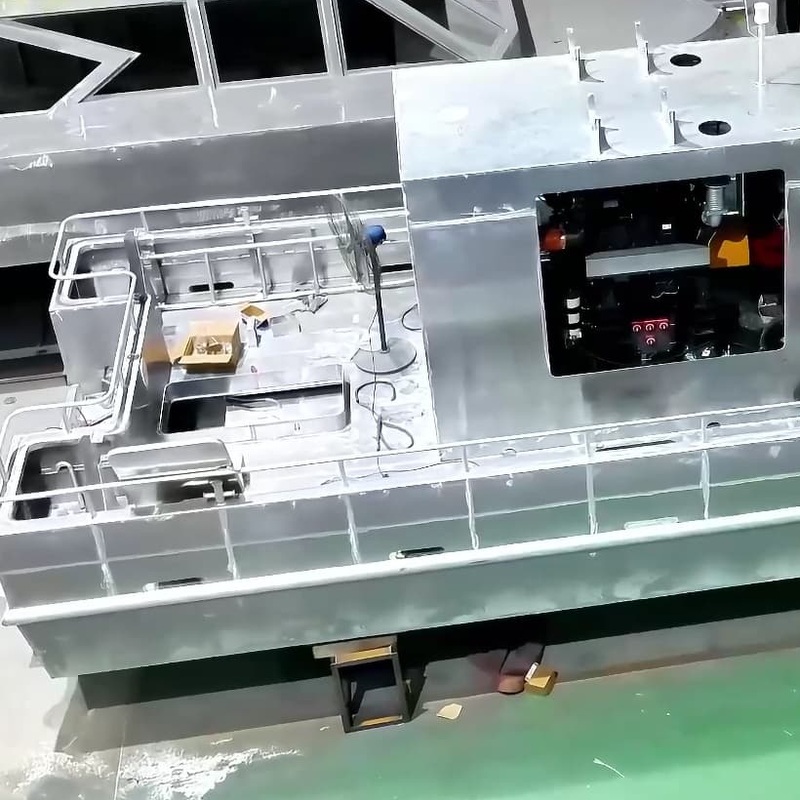
Aluminium plate for hull structure is normally supplied against EN 10204, which defines four inspection document types. The distinction that matters commercially is not the table of test results - it is who signs.
| Type | Issued by | Specific test results | Practical meaning |
|---|---|---|---|
| 2.1 | Manufacturer, own declaration | No | Confirms conformity to order, nothing more |
| 2.2 | Manufacturer | Yes, but not specific to the batch | Acceptable for non-structural items |
| 3.1 | Manufacturer plus its independent inspection representative | Yes, specific to the batch | The usual baseline for hull structure |
| 3.2 | Manufacturer plus the purchaser's authorised representative or an independent third party | Yes, specific to the batch, countersigned on the buyer side | Where the buyer wants independent confirmation |
A purchase order that says "material certificate required" will be satisfied by a 2.1. Write the type number, and require the heat number on the certificate to match the marking on the plate. Filler wire deserves the same treatment as plate: a hull can be correctly certified and still be welded with undocumented consumables.
Welding procedure qualification for aluminium is governed by ISO 15614-2. The current edition is the 2025 second edition, which replaced the 2005 text and its two corrigenda. This is a recent change, and it is worth asking which edition a supplier's qualification record was produced under.
The sequence is straightforward but often abbreviated in practice. A preliminary welding procedure specification (pWPS) is a proposal. It becomes qualified only after test pieces are welded, examined and shown to meet the required level, producing a welding procedure qualification record (WPQR). Submitting a pWPS as if it were a qualification is a common and avoidable error.
The scope of a WPQR is bounded. Material group, thickness range, welding position, joint type, process and polarity all constrain where it may be applied. A procedure qualified on 6 mm plate does not automatically cover 12 mm. Work outside the qualified range is unqualified work, regardless of how experienced the welder is.
ISO 9606-2 covers the qualification of welders for fusion welding of aluminium. A welder holding a valid certificate can still be unqualified for the job in front of them, because the certificate is bounded by process, position, thickness and pipe diameter.
Two failures recur. A yard presents a full set of welder certificates that turn out to be steel qualifications, which do not transfer - aluminium is a separate part of the standard for good reason. Or a welder qualified for tungsten inert gas welding is set to run long straight seams with metal inert gas, which is a different process entry on the certificate.
"Inspected and accepted" is not a result. A usable report names the method, the extent and the acceptance level it was judged against.
Visual examination - ISO 17637, judged against the applicable weld quality level.
Radiographic examination - technique to ISO 17636-2 (2022 edition for digital detectors), acceptance levels for aluminium butt welds to ISO 10675-2 (2021 edition).
Penetrant examination - acceptance levels to ISO 23277 (2015 edition, levels 1 to 3).
Aluminium hulls carry a large proportion of fillet and T-joints that radiography cannot reach, so penetrant testing does much of the surface work. That makes the penetrant acceptance level as important to agree as the radiographic one.
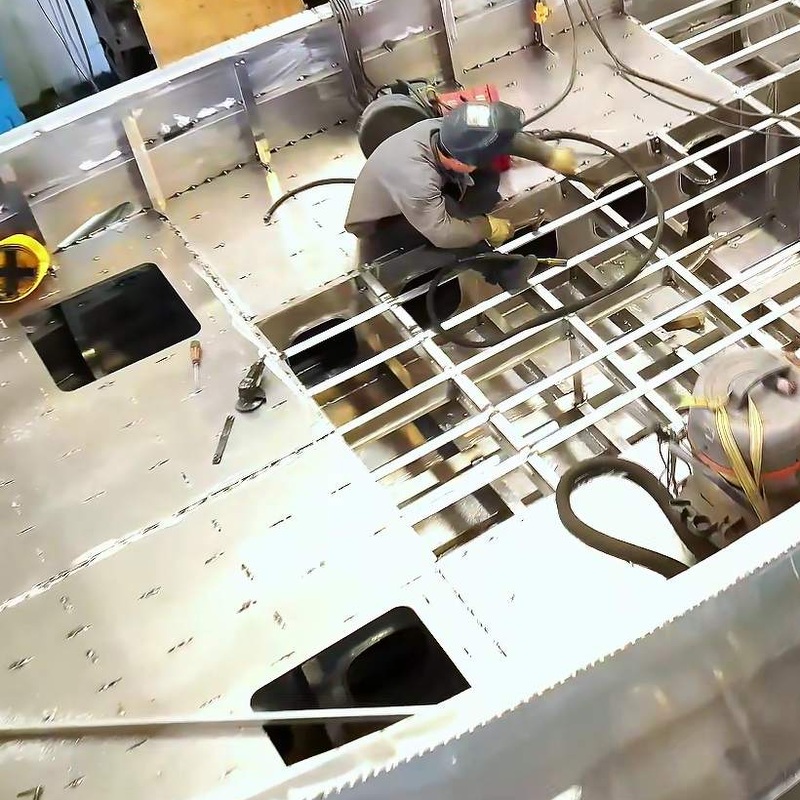
Weld quality levels for aluminium are defined in ISO 10042. Steel uses a parallel but separate system, ISO 5817. The radiographic acceptance levels split the same way: ISO 10675-1 for steel, nickel and titanium, ISO 10675-2 for aluminium.
A report citing ISO 5817 or ISO 10675-1 against an aluminium hull has borrowed the wrong standard. It is not a stricter result or a looser one - it is simply not a judgement of the item in front of the inspector. Our earlier note on what weld quality levels B, C and D actually control covers how the level itself is chosen; this article covers the paperwork that proves it was achieved.
These eight lines, answered in writing before contract, remove the ambiguity that causes handover disputes:
Mill certificate type: EN 10204 type ___, with heat number traceable to the plate marking.
Filler wire certificate type and the basis for matching it to the parent metal.
WPQR standard and edition: ISO 15614-2, edition ___, covering ___ to ___ mm.
Welder qualification: ISO 9606-2, process ___, position ___, valid to ___.
Weld quality level: ISO 10042 level ___ (B, C or D), per which contract document.
NDT methods and extent: visual ___%, radiographic ___% (ISO 10675-2 level ___), penetrant ___% (ISO 23277 level ___).
Procedure for rejecting and re-examining a weld that fails.
Whether the vessel is classed, and if so to which society and rule edition.
Items five and six are the two that are most often left vague, and the two most likely to be argued over at delivery. A quality level is a purchasing decision, not a builder's default: if the contract is silent, there is no agreed benchmark to inspect against.
None of these documents take long to produce while the work is happening. The WPQR should exist before the first production weld, not after the first rejection. Mill certificates arrive with the plate or they never arrive. NDT reports are written at the time of examination and cannot be reconstructed convincingly later.
The aluminium workboats we build are documented as a chain rather than a single certificate, and the aluminium work barge range is where that documentation habit matters most, because barges are welded almost entirely in fillet and T-joints. If you are preparing an RFQ and want the eight items above answered against a specific design, send us the specification and we will respond line by line.


