

Views: 0 Author: Site Editor Publish Time: 2026-10-12 Origin: Site


The allure of the open ocean is undeniable. For those seeking the pinnacle of maritime comfort, multihull vessels offer unmatched stability and expansive living spaces. Stepping aboard a well-designed multihull instantly reveals a spatial paradigm that traditional single-hull boats simply cannot replicate. But how do you get from a dream to a signed specification sheet? The process often feels overwhelming.
You might be planning a Mediterranean vacation. Or perhaps you are commissioning a custom build for global cruising. Knowing exactly how to configure the vessel is critical. The wrong layout, an inefficient crew setup, or an unsuitable hull material will drastically diminish your onboard experience. This guide serves as your blueprint. Meticulous planning is the key to creating a vessel that perfectly aligns with your maritime ambitions.
Define Your Purpose First: Specifications must align with the primary function. A high-yield charter business requires universally appealing layouts and robust commercial systems. A private family getaway prioritizes bespoke customization.
Size Is More Than Length: Interior volume, beam width, and intelligent cabin configurations matter significantly more than the overall length.
Power vs. Sail: The choice between a traditional sailing rig and motorized propulsion depends entirely on your required cruising speed, fuel efficiency goals, and typical itinerary.
Material Matters: For long-distance global cruising, advanced metal construction provides superior structural strength and complete customization capabilities compared to standard fiberglass production boats.
Crew and Amenities Dictate the Experience: A true luxury experience relies heavily on properly specified crew quarters and high-end amenities. Think commercial-grade galleys and specialized water toy storage.
The specification process must begin with a crystal-clear understanding of the end-use. The operational demands of a commercial charter business are vastly different from the gentle usage of private family cruising. Establishing this primary purpose early prevents costly refits down the line. It ensures the vessel operates efficiently within its intended environment.
When building explicitly for the charter market, universal appeal and return on investment dictate almost every design choice. The layout must maximize the number of paying guests without making the space feel cramped. A highly successful configuration typically includes four to six equal-sized en-suite cabins. This deliberate parity prevents guests from arguing over who receives the master suite. It streamlines the booking process for large groups.
From a practical engineering standpoint, charter vessels require commercial-grade durability. High-traffic usage demands scuff-resistant interior laminates rather than delicate wood veneers. System redundancy is non-negotiable. Dual watermakers, oversized continuous-duty generators, and heavy-duty marine HVAC systems are essential. You cannot afford mechanical downtime during a lucrative charter week.
Private ownership allows for a highly personalized approach to yacht design. The focal point of a private multihull is usually the owner-centric layout. This configuration dedicates an entire hull to a master suite. It transforms the space into a private sanctuary complete with a king-sized berth, a secluded lounge area, walk-in wardrobes, and an expansive en-suite bathroom.
Beyond spatial adjustments, private vessels prioritize specialized storage and customized technical integrations. Owners planning extended global voyages will specify deep-freeze provision storage and dedicated dive gear lockers with integrated compressors. They also favor personalized smart-yacht automation systems that might prove too complex for short-term charter guests to navigate safely.
| Specification Focus | Commercial Charter | Private Ownership |
|---|---|---|
| Layout Strategy | 4 to 6 equal-sized cabins to maximize guest count and ROI. | Dedicated owner's hull with custom suites and private lounges. |
| System Redundancy | Dual watermakers, continuous-duty commercial generators. | Smart-yacht automation, deep-freeze storage, extensive solar arrays. |
| Interior Finish | Scuff-resistant laminates for high-traffic durability. | Bespoke wood veneers and custom architectural lighting. |
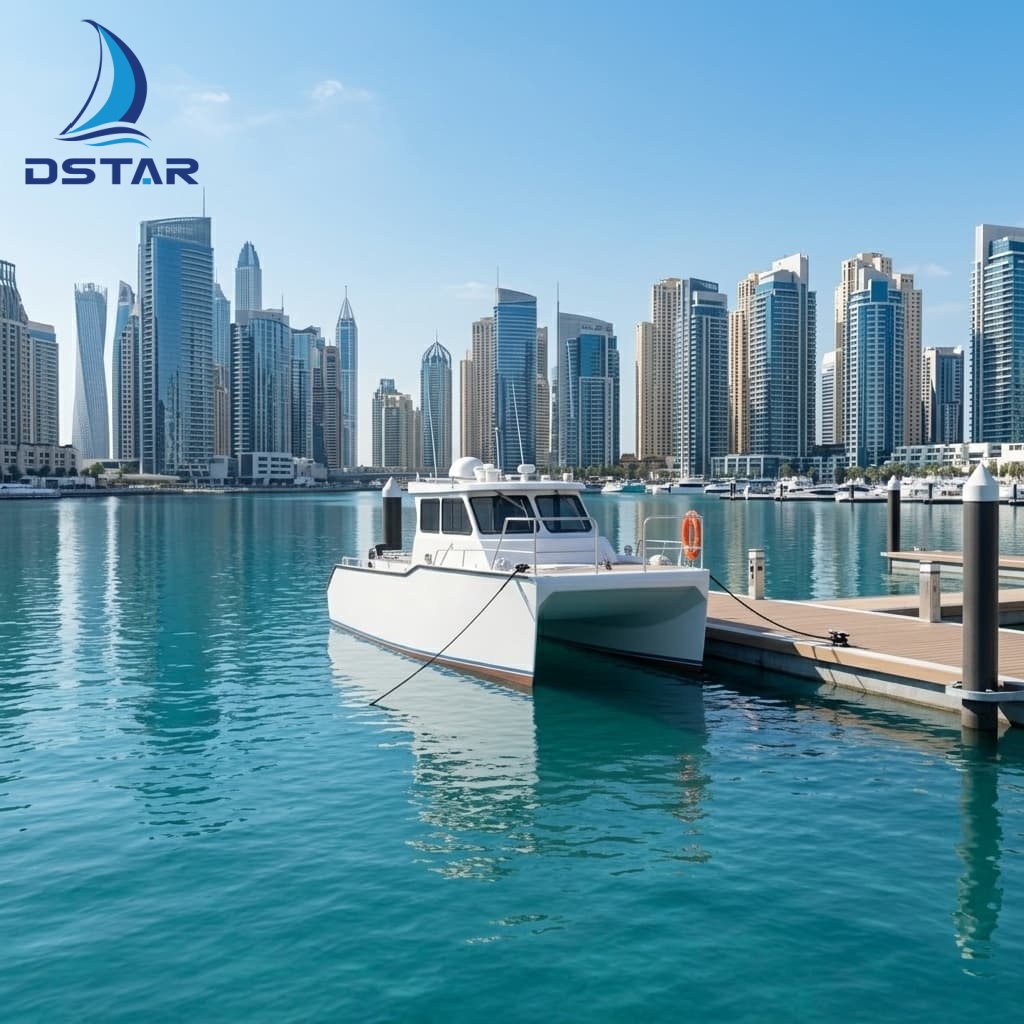
A persistent misconception in the yachting industry is evaluating a vessel's capability purely by its overall length. While length is certainly a factor, multihulls operate on an entirely different spatial geometry than their monohull counterparts.
The defining characteristic of a multihull is its massive beam. Because the width is typically about half the length of the vessel, a 50-foot catamaran offers a footprint roughly 25 feet wide. This immense platform provides the interior volume and deck square footage equivalent to a much larger Luxury Motor Yacht. When specifying your build, it is far more accurate to focus on gross tonnage and usable deck space rather than fixating on length alone.
Selecting the correct size ensures both comfort and safety for your expected passenger count. A vessel in the 40 to 50-foot range is highly efficient for one to two families. It remains manageable for an experienced owner-operator while offering sufficient space without requiring a massive crew. Stepping up to the 50 to 65-foot range hits the sweet spot for luxury crewed charters. This size comfortably accommodates six to eight guests alongside dedicated quarters for a professional crew. Entering the 70-foot and above category places you in superyacht territory. Here, vast volumes allow for commercial-scale galleys, expansive beach clubs, and quarters for a larger hospitality team.
The choice of propulsion fundamentally alters the naval architecture, daily operation, and maintenance schedule of the vessel. Both sailing and motorized multihulls offer distinct advantages. The decision should be driven by your lifestyle and intended cruising grounds.
Sailing catamarans deeply appeal to maritime purists and eco-conscious cruisers. By harnessing wind power, these vessels drastically reduce fuel consumption during long ocean passages. The experience of silent cruising under sail holds a strong romantic appeal. However, this approach requires a deep understanding of complex sail plans, rigorous rigging maintenance, and strategic weather routing.
For those who prioritize predictable travel schedules and maximum interior volume, the Catamaran Power Yacht stands out as an optimal engineering choice. By eliminating the heavy mast, complex rigging, and bulky sail lockers, naval architects can repurpose that weight and space. Take a modern 32-foot high-speed aluminum catamaran platform as a baseline. The removal of sailing gear allows for larger twin engines, vastly increased fuel capacity, and expansive upper-deck lounges that stretch all the way forward.
These vessels offer higher cruising speeds and a shallower draft. They are the perfect platform for island-hopping in regions with notoriously shallow waters. They provide familiar joystick handling and consistent point-to-point transit times regardless of shifting wind conditions.
Fiberglass remains the standard for mass-produced charter fleets. Yet, discerning buyers commissioning custom builds are increasingly turning to advanced metal construction. Understanding the material science behind your vessel is critical for ensuring long-term safety and structural integrity.
Fiberglass boats are inherently constrained by fixed molds. If a buyer wishes to move a structural bulkhead or alter the hull shape to accommodate a specific interior layout, the tooling costs are often prohibitive. Metal construction is not bound by molds. Specifying an Aluminum Luxury Yacht allows for bespoke customization of both the hull and the superstructure. Owners possess the freedom to dictate exact dimensions, custom window placements, and unique structural layouts.
For serious global explorers navigating unpredictable waters, safety is paramount. Marine-grade aluminum possesses a high modulus of elasticity. It absorbs significant impact energy by denting rather than shattering like rigid fiberglass. This characteristic provides a critical safety margin when navigating remote areas prone to floating debris or uncharted coral reefs. Aluminum is inherently fire-resistant and completely immune to hull blistering. This drastically reduces long-term maintenance headaches.
Furthermore, metal hulls offer an exceptional weight-to-strength ratio. An aluminum structure is highly rigid, resisting heavy flexing in rough seas. Despite this formidable strength, advanced engineering allows an aluminum hull to remain surprisingly lightweight. This translates directly into lower hydrodynamic drag, lower fuel consumption, and an extended range.
The distinction between a standard production boat and a true luxury platform lies in the thoughtful specification of high-end amenities. Allocating your budget toward the right features directly impacts guest satisfaction and operational ease.
Modern multihulls have elevated the flybridge into the premier social zone. When configuring this space, specifying a rigid aluminum hardtop is highly recommended over flimsy canvas covers. A hardtop provides permanent shade, supports overhead architectural lighting, and creates a stable platform for high-yield solar panel arrays. If adding a heavy jacuzzi on the forward deck, careful structural planning is required to handle the immense water weight. An aluminum framework excels here, engineered specifically to support heavy amenities without compromising stability.
A luxury vessel serves as a basecamp for aquatic exploration. Specifying a robust hydraulic swim platform is essential. It acts as a submerged beach club for guests while providing a safe, mechanized system for launching and retrieving heavy tenders. Design dedicated garage spaces for modern water toys. This ensures the main decks remain pristine and uncluttered.
The human element of yachting requires just as much precise specification as the mechanical systems. The intended operational model dictates the layout of the cabins, the complexity of the helm station, and the overall flow of the vessel.
Delivering a high-end charter experience requires a rested professional crew. Specifying adequate crew quarters is an absolute necessity. These cabins should be entirely separate from the guest areas, feature their own en-suite facilities, and provide independent access to the deck. This thoughtful layout minimizes guest disturbance during early morning preparations.
If the vessel is intended for experienced owner-operators who value complete privacy, the specification must pivot toward ease of handling. A bareboat setup requires systems that allow for safe, short-handed operation. Essential upgrades include electric winches, all running lines led aft to a centralized helm station, advanced autopilot systems, and powerful proportional bow thrusters to assist with docking in crosswinds.
A yacht specified for the icy waters of the Arctic will perform poorly in the tropics. The primary operational region dictates specific technical and environmental requirements.
Cruising the Mediterranean presents unique logistical challenges. The region relies heavily on stern-to mooring techniques requiring the vessel to reverse tightly to a concrete quay. Specifying a robust hydraulic gangway is mandatory for safe guest boarding. The intense summer heat requires high-capacity tropical-rated air conditioning systems. These consequently demand larger continuous-duty generators to handle the electrical load.
In contrast, the Caribbean and Bahamas are characterized by remote anchorages and exceptionally shallow coral banks. Draft is a critical metric here. Specifying a vessel with a shallow draft allows access to secluded coves that deeper single-hull boats simply cannot reach. Because marina infrastructure is sparse, the yacht must be highly self-sufficient. This necessitates specifying high-capacity watermakers, oversized lithium-ion battery banks, and extensive solar panel arrays.
Looking closely at recent market shifts, the specification process is evolving rapidly. There is a significant movement toward hybrid operational models. Owners are increasingly designing vessels that can seamlessly transition between acting as private family sanctuaries and highly lucrative charter assets. Current data indicates a surging demand for eco-conscious onboard systems. Buyers are actively specifying high-capacity lithium battery banks paired with expansive solar arrays to reduce reliance on fossil fuels.
Furthermore, the marine industry is witnessing a distinct pivot away from mass-produced fiberglass hulls toward advanced metal constructions. This trend is driven by a growing desire for completely bespoke interior layouts and the superior safety margins required for ambitious remote global cruising itineraries.
Specifying a luxury catamaran yacht is a meticulous process. It balances spatial geometry, propulsion preferences, material science, and high-end amenities to match your exact lifestyle or business goals. Whether you envision hosting large charter groups or embarking on a private off-grid expedition, every technical choice shapes the final experience. By carefully evaluating your core purpose and understanding the profound impact of layout and materials, you ensure your investment translates into unparalleled moments on the water. Meticulous planning today guarantees a flawless voyage tomorrow.
Ready to start your custom build? Visit https://www.dstaryacht.com to explore high-performance aluminum platforms and find the exact vessel specifications that match your maritime vision.
The primary distinction lies in the hull architecture and its resulting hydrodynamic benefits. A catamaran utilizes two parallel hulls. This provides up to forty percent more interior and exterior living space compared to a single-hull boat of the exact same length. This dual-hull design inherently offers enhanced stability, virtually eliminating the uncomfortable side-to-side rolling motion while at anchor. The slender profile of the two hulls creates significantly less drag in the water, resulting in superior fuel efficiency and extended cruising ranges.
Aluminum offers distinct structural and practical advantages for serious global cruisers. Unlike fiberglass, which requires expensive pre-designed molds, aluminum allows for complete bespoke customization of the hull and superstructure. Materially, marine-grade aluminum is highly resistant to impact from floating debris or accidental reef groundings. It provides a superior safety margin. Aluminum will never suffer from hull blistering, is inherently fire-resistant, and maintains an excellent weight-to-strength ratio.
For a group of eight guests to travel in absolute comfort without feeling crowded, a multihull measuring between 50 and 60 feet in length is generally the ideal specification. A vessel of this volume easily accommodates four spacious equal-sized en-suite cabins dedicated entirely to guests. Beyond the sleeping quarters, a yacht of this size provides expansive communal areas. Crucially, a 50 to 60-foot platform also allows for separate dedicated crew quarters in the bow compartments.
To successfully compete in the high-end charter market, a yacht must be specified with amenities that guarantee uninterrupted comfort. Absolute must-haves include high-capacity watermakers and robust tropical-strength air conditioning systems. A hydraulic swim platform is essential for safe water access and effortless tender management. High-speed satellite internet is no longer considered a luxury but a baseline expectation. A diverse inventory of modern water toys is critical for delivering a premium aquatic experience.
When properly maintained, a marine-grade aluminum yacht can easily exceed a lifespan of 50 years. Unlike fiberglass, which can degrade under UV exposure and suffer from osmotic blistering over time, aluminum forms a natural oxide layer that prevents deep corrosion. With routine galvanic anode replacements and proper paint system maintenance, the structural integrity of an aluminum hull remains incredibly stable across decades of heavy ocean use.
Sailing catamarans generally have lower fuel costs, especially on long ocean crossings. However, they require significant periodic investments in rigging replacement, sail repairs, and specialized deck hardware maintenance. Power catamarans incur higher direct fuel costs and require strict engine servicing schedules. Yet, they eliminate the expensive cycle of replacing worn sails and complex standing rigging. For coastal cruising and island-hopping, the overall annual maintenance costs often balance out between the two platforms.


