

Views: 0 Author: Site Editor Publish Time: 2026-10-15 Origin: Site


A boat is ordered as a general arrangement drawing, a specification and a delivery date. What turns those documents into a vessel is a sequence of stages that most owners never see — and the quality of the finished boat is largely decided in the first two of them. Here is what actually happens on the shop floor between order and handover.
Everything starts on the build jig. The keel line and stations are set out, and the transverse frames are erected and aligned to those stations — for a welded hull the frame spacing, the fairness of the hull and the alignment of the keel and shaft line are all fixed here. Errors at this stage cannot be corrected later without cutting the boat apart, which is why a hull is only "straight" if the jig work was right.
It is also the stage where the material choice becomes visible. An aluminum hull shows its welded stringers and plate seams as the structure goes up; a steel hull shows the frames and floors in the same way. Owners who visit during this stage see the vessel's skeleton — and can still change internal arrangements at low cost.
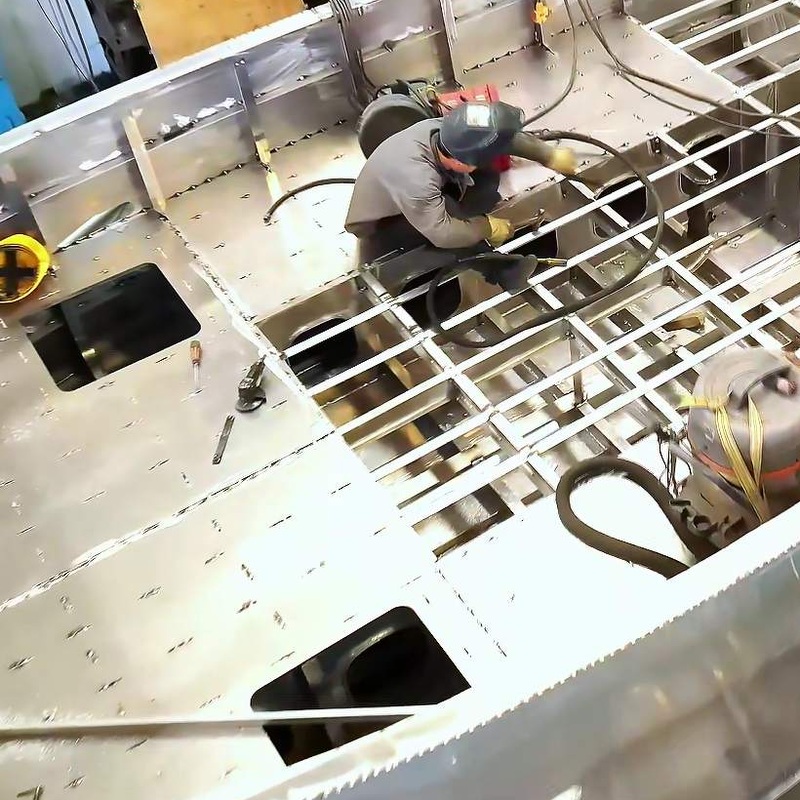
Once the frames stand, shell plating is fitted and welded, followed by decks, bulkheads and tanks. This is the stage that decides whether the boat will be watertight and fatigue-resistant for the next twenty years. Weld preparation, fit-up, sequence and penetration matter more than any specification sheet: an undercut seam or a poorly fitted plate will eventually crack, and a hull that is not properly aligned can never be made fast.
For aluminium the work is TIG/MIG and demands skill to avoid distortion and stress concentrations. For steel it is a heavier, more forgiving process, which is part of the material's appeal. In both cases the yard should be able to show weld inspection, plate thickness records and tank testing before the hull is closed.
With the structure complete, the hull is closed in and protected — priming, fairing and coating, and for steel, the full coating system that stops corrosion in the first place. Building under cover matters here: welding and painting done in the open are at the mercy of rain, humidity and wind, and the result is blistering and early corrosion. This is why the workshop is an inspection point in its own right.
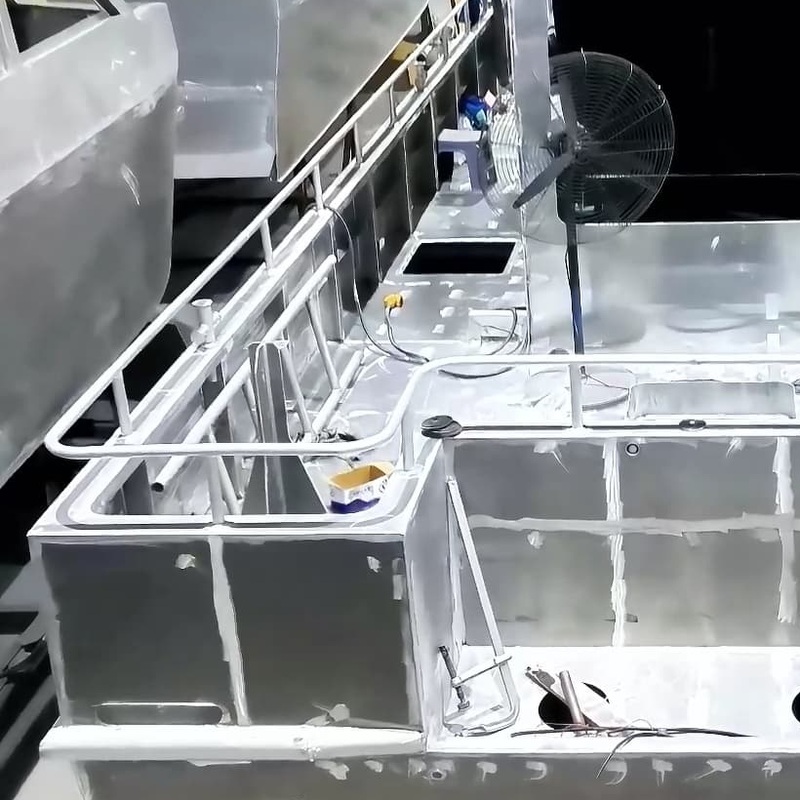
Once the hull is closed and protected, outfitting begins: main engines and shafting or outboard transoms, fuel and water tanks, bilge, fire and fresh-water systems, electrical distribution, navigation and communication equipment, wheelhouse, seating and saloon joinery. On a passenger vessel this stage usually carries the largest share of the specification — and the largest share of the cost.
This is also where a custom build earns its keep. Rather than compromising to a catalogue layout, the saloon, walk-on access, seating and safety arrangements are built to the route the operator actually runs. Our custom steel passenger vessel and the aluminum fire fighting barge are both built this way — the hull is a platform, and the outfitting is the product.
Finally the vessel is launched, ballasted and settled, then put through dock and sea trials: speed and fuel consumption, manoeuvring, steering, systems and safety equipment. Only after trials and any snagging is the boat handed over with its documentation, drawings and certification.
Four questions keep a project honest. Ask to see the jig and alignment records before welding starts. Ask for weld inspection and tank test records before the hull is closed in. Ask whether the build is under cover. And ask for a stage-by-stage payment and inspection schedule rather than a single delivery date. A yard that can answer all four is one that expects you to look.
If you are planning a build, send us the route, the duty and the delivery target — we will set out the programme, the material the job calls for and the cost basis on which we would quote it. Details of the current range are on our products page, and you can contact us directly. More technical notes are in our news section, or start from the Dookyu Crown homepage.


