

Views: 0 Author: Site Editor Publish Time: 2026-10-19 Origin: Site


Buyers usually ask the wrong welding question. "Is it TIG or MIG?" tells you which process was used; it tells you nothing about whether the finished weld is acceptable. The question that actually governs hull integrity is: what quality level are the welds held to, and who checks them?
For aluminium, the acceptance criteria are set out in ISO 10042:2018 — Welding — Arc-welded joints in aluminium and its alloys — Quality levels for imperfections. It applies to material thicknesses above 0.5 mm and covers full-penetration butt welds and all fillet welds.
The standard defines three quality levels, designated B, C and D. Level B corresponds to the highest requirement on the finished weld; C and D are progressively more permissive. The levels exist so that the same standard can serve a wide range of welded constructions, from a non-critical bracket to a hull bottom that works in fatigue.
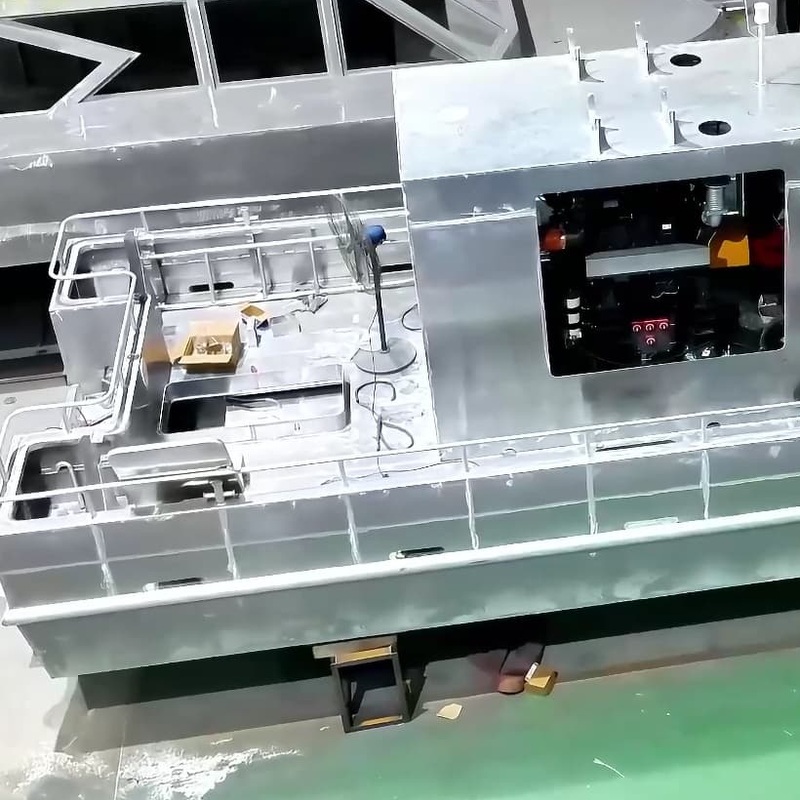
A quality level is not a description of how neatly the bead is laid. It is a set of acceptance limits applied to imperfections — the discontinuities that every welding process produces to some degree. Choosing a level is a design decision: it tells the builder how much imperfection is tolerable in that joint, given what the joint has to do.
That is why the level belongs in the specification, not in a verbal agreement on the shop floor. "Good welds" is not a specification. "Fillet and full-penetration butt welds to ISO 10042 quality level B in the hull structure" is.
Two properties of the material make the acceptance question sharper than it is for steel.
First, 5083 is a non-heat-treatable, work-hardened alloy. Its strength comes from the temper, not from heat treatment — which means it cannot recover strength by heat treatment after welding. The heat-affected zone around every weld is softer than the parent plate, and that is a permanent condition of the structure. Joint design and plate thickness have to account for it from the outset.
Second, aluminium conducts heat away from the weld pool far faster than steel, so heat input and fit-up have to be controlled tightly to avoid lack of fusion and distortion. Neither of these is a reason to avoid aluminium — it is a reason to specify the acceptance level and inspect against it.
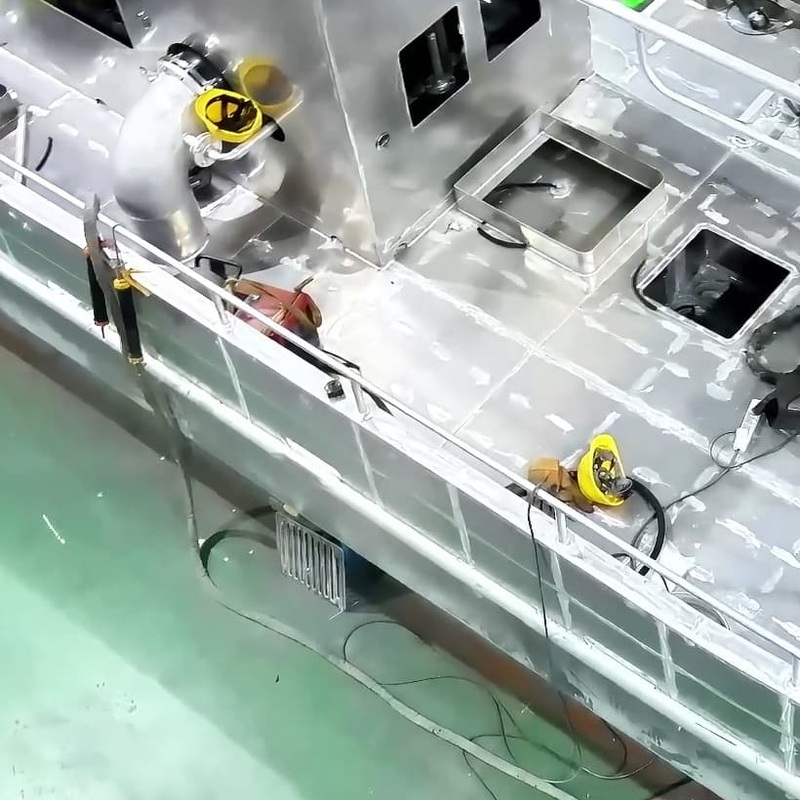
Three requests separate a controlled welding programme from an optimistic one:
The specified quality level, per joint group — and the standard it is measured against (for aluminium, ISO 10042).
Welder qualification records for the process and position actually used on your hull.
Inspection records — which joints were examined, by what method, and what the results were.
A builder who can answer all three without going away to look for paperwork is operating a quality system. A builder who answers "our welders are very experienced" is describing a person, not a process.
On our aluminium hulls — from the 11.5m fire barge through the patrol and work boat range — the structural joints are specified to a stated ISO 10042 quality level and inspected against it; the level is recorded in the build documentation rather than agreed informally. On the steel side, the equivalent discipline applies to the steel passenger vessels, where the acceptance criteria come from the corresponding steel welding quality standard rather than the aluminium one.
The broader product range and the steel boat line are built the same way. If you are comparing quotations from several yards, ask each of them the three questions above and compare the answers — the difference in price usually shows up there first. Send us your specification and we will tell you which level we would propose for each joint group.


