

Views: 0 Author: Site Editor Publish Time: 2026-10-16 Origin: Site


Stand at any busy coastal terminal, and you will notice a common operational headache. Passengers eagerly await their island getaway, yet they dread the rough ride. Traditional deep-V monohull ferries have a history of reliability. However, they struggle in cross-seas. They induce severe seasickness. They also burn excessive fuel just to push massive bow waves. Deep drafts severely limit their docking options during low tides.
A modern catamaran architecture solves these exact operational bottlenecks. By distributing the vessel displacement across two slender pontoons, multihull designs fundamentally alter the dynamics of short-route transit. This guide breaks down the commercial advantages of fleet upgrades from an engineering perspective. You will learn how to select the exact vessel specification for your local marine environment.
Unmatched Stability: Twin-hull designs offer a significantly smoother ride. They virtually eliminate the pendulum-like roll that causes passenger seasickness on choppy short-distance island routes.
High Operational ROI: Advanced hydrodynamics reduce water resistance. This leads to measurable fuel efficiency and substantially lower long-term operational expenditures.
Versatile Docking: A shallow draft allows multihull vessels to access remote islands, tidal zones, and shallow ports that traditional deep-V hulls simply cannot reach.
Optimized Passenger Flow: Wider beams enable spacious layouts, rapid boarding, and efficient disembarking. These are crucial factors for maintaining strict short-route schedules.
Safety and Redundancy: Dual hulls and split twin-engine setups provide built-in mechanical redundancy. This ensures top-tier safety for commercial maritime operations.
Recent maritime data indicates a massive structural shift in coastal transport. Global operators face stricter emission regulations alongside rising fuel costs. Consequently, the commercial sector is rapidly abandoning traditional single-hull designs. Industry analyses show a sharp increase in multihull fleet acquisitions for short-distance networks over the past decade. This pivot is driven by the need for eco-conscious transit that maintains high payload capacities. Modern operators demand platforms that deliver lower operational expenditures per nautical mile while elevating the commuter experience.
This transition is not merely a design trend. It is driven by hard empirical data. Multihulls consistently deliver superior passenger comfort metrics. They align perfectly with the industry push for sustainable and high-yield maritime operations.
To grasp why fleet managers make this shift, we must evaluate the fundamental physics of both hull types. The wide stance of a catamaran is inherently superior for frequent stops and shallow-water navigation. By separating buoyancy into two distinct pontoons, shipbuilders maximize usable deck space. This is achieved without a proportional and costly increase in overall vessel length.
Below is an objective engineering comparison illustrating how these two hull types perform in commercial short-route environments:
| Operational Metric | Traditional Monohull | Catamaran Architecture |
|---|---|---|
| Draft Depth | Deep. Requires dredged or deep-water ports. | Shallow. Accessible to remote island piers and tidal zones. |
| Stability and Roll | High roll tendency in cross-seas. | Exceptional transverse stability with minimal rolling. |
| Deck Space | Tapered at the bow resulting in limited width. | Rectangular footprint yielding up to 40 percent more usable space. |
| Fuel Efficiency | High drag requires massive horsepower. | Low wetted surface area allows higher speeds with less fuel. |
| Turnaround Time | Slower due to narrow aisles and single boarding points. | Fast due to wide aisles and multi-gate boarding capabilities. |
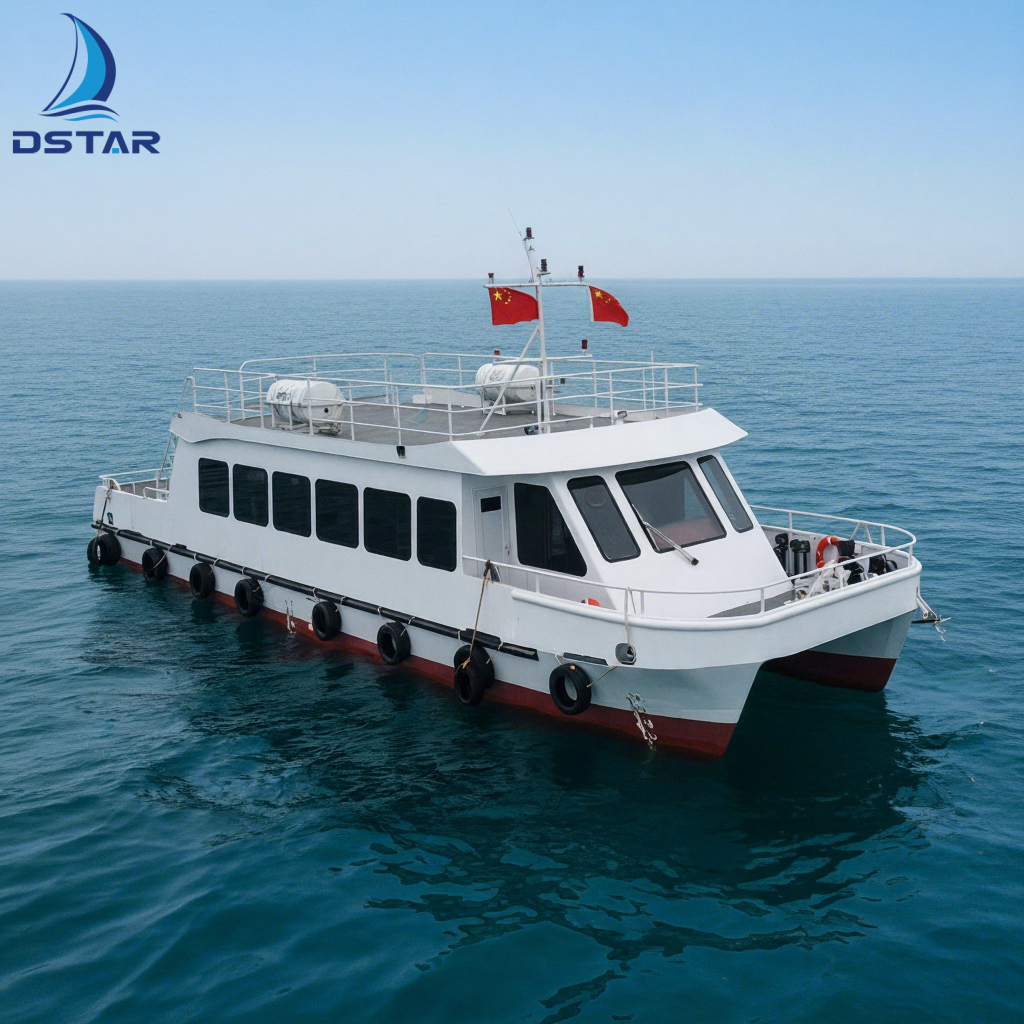
Investing in a commercial fleet requires a rigorous evaluation of technical traits. A reliable Passenger Ferry Boat must meet strict criteria for safety, mechanical efficiency, and onboard comfort. The following engineering characteristics define high-quality multihull ferries built for daily transit rigors.
The physics of twin hulls provide a massive advantage in transverse stability. The vessel buoyancy is concentrated at the extreme outer edges of its footprint. This significantly increases the metacentric height. Such structural geometry effectively eliminates the nauseating roll that monohulls experience when struck by beam seas.
For commercial operators, this translates into a dramatic reduction in passenger seasickness. Smooth and stable rides lead to excellent customer reviews. They reduce onboard medical incidents and drive repeat ticket sales.
Island transit routes frequently involve poorly charted atolls and shifting sandbars. Coastal regions also suffer from extreme tidal fluctuations. A catamaran typically draws significantly less water than a monohull of identical capacity. For instance, a standard 62-foot multihull might draw less than a meter of water.
Navigating through a coral-fringed archipelago during a dropping tide becomes a routine task. This shallow draft allows captains to maintain strict timetables regardless of tidal changes. It permits safe docking at rudimentary island piers. Ultimately, this operational versatility opens up lucrative new routes.
Fuel costs represent the largest variable expense for fleet operators. Therefore, hydrodynamic efficiency is paramount. Catamarans achieve an optimal speed-to-fuel ratio due to their reduced wetted surface area. The slender dual pontoons act like knives slicing cleanly through the water. They do not bulldoze a massive bow wave.
Consequently, the vessel experiences far less hydrodynamic drag. This efficiency allows operators to achieve aggressive cruising speeds of 20 to 25 knots using smaller engines. The result is calculable and compounding savings on high-frequency transit loops.
A vessel must transcend basic utility to serve as an excellent platform for tourism. Designing meticulously for the passenger experience ensures you can confidently command premium ticket pricing.
The exceptionally wide beam of a multihull creates an expansive rectangular main deck. This geometric advantage allows naval architects to incorporate large panoramic viewing windows. They can install spacious airline-style seating arrangements without compromising the width of central aisles.
Furthermore, this inherently stable platform is ideal for integrating open-air observation decks. These premium features effortlessly transform a utilitarian commuter ferry into a highly marketable Sightseeing Transport Boat. Operators can sell lucrative scenic coastal tours alongside their standardized transit schedules.
On short-route island services, your profit margin is dictated by daily trip volume. Every minute spent idling at the dock represents lost revenue. The wide footprint of a catamaran accommodates multi-point boarding gates and compliant wheelchair ramps. It features exceptionally wide interior walkways.
Specifically, this optimized passenger flow prevents bottlenecks. Hundreds of passengers and their luggage can disembark and board in a fraction of the time required on a traditional ferry. This rapid turnaround maximizes daily asset utilization.
Procuring a new vessel is ultimately a mathematical exercise. The evaluation must look past the initial sticker price. It should focus heavily on the Total Cost of Ownership and the projected Return on Investment.
The hydrodynamic efficiency of twin hulls yields substantial recurring returns. Depending on the route profile and sustained cruising speed, a catamaran can consume 15 to 30 percent less fuel annually compared to a monohull bearing the same passenger load.
Over a standard operating year comprising 3,000 engine hours, this reduction translates into massive direct savings. This drop in overhead significantly accelerates the break-even timeline for the vessel.
Commercial vessels operate relentlessly in highly corrosive saltwater environments. Fortunately, catamarans offer distinct practical maintenance advantages. In modern designs, the primary engines, generators, and critical filtration systems reside in separate spacious compartments within each pontoon.
This ergonomic accessibility drastically reduces billable labor hours for routine maintenance. Mechanics can perform oil changes, belt replacements, and engine overhauls much faster. Coupled with robust structural integrity, operators can confidently amortize their capital expenditure over decades of active service.
Selecting the appropriate hull material is a foundational engineering decision. It dictates the vessel dry weight, fuel consumption profile, and operational lifespan. Operators generally evaluate marine-grade aluminum, fiberglass reinforced plastic, and steel.
Marine-grade aluminum is highly revered in the fast-ferry sector. It offers an exceptional strength-to-weight ratio. An aluminum catamaran is significantly lighter than composite counterparts. This translates to lower displacement and reduced horsepower requirements. Aluminum also offers high impact resilience, tending to dent rather than shatter upon striking floating debris.
In contrast, fiberglass is the premier choice for operators seeking series-produced vessels with flawless aesthetics. While initial mold creation is costly, it drives down the per-unit cost for bulk fleet orders. Fiberglass provides a sleek finish and is immune to galvanic corrosion. However, it is heavier than aluminum, which marginally impacts top-end cruising speeds.
Certain unforgiving operational environments demand a different caliber of structural integrity. Routes navigating through debris-choked river mouths or icy coastal waters must prioritize raw durability over sheer speed.
In these rigorous conditions, steel remains the undisputed heavyweight champion. It provides unparalleled impact resistance and immense structural rigidity. If your operational profile prioritizes heavy-duty endurance and massive payloads, investing in a robust Commercial Passenger Vessel built from marine steel provides a virtually indestructible long-term asset.
| Characteristic | Marine-Grade Aluminum | Fiberglass Composite | Marine Steel |
|---|---|---|---|
| Weight and Displacement | Lightest | Medium | Heaviest |
| Fuel Efficiency | High due to low weight | Moderate | Lower due to higher power demands |
| Impact Resistance | High. Dents on impact. | Moderate. Prone to cracking. | Maximum. Extreme structural rigidity. |
| Customization Flexibility | Extremely High. No molds needed. | Low. Requires expensive molds. | High. Fully welded construction. |
| Maintenance Profile | Requires strict anode monitoring | Low hull maintenance | Requires regular anti-rust coating |
Safety is the non-negotiable foundation of commercial transport. Regulatory bodies heavily scrutinize passenger vessels. Catamarans possess inherent design traits that actively enhance onboard safety during adverse weather events.
One of the most profound safety advantages of a catamaran is its mechanical redundancy. Traditional monohulls rely on a single centralized engine room. A catamaran isolates its propulsion systems within two entirely separate pontoons. The vessel operates with independent fuel lines, cooling intakes, and exhaust networks.
In the event of a catastrophic mechanical failure or a localized engine fire, the incident remains fully isolated. The captain can swiftly secure the compromised hull. They can safely navigate back to port using the independent propulsion system on the opposite side. Passengers are never left stranded adrift.
Procuring a commercial vessel means adhering to rigorous standards set by international classification societies like the USCG or IACS. Due to their wide stance and compartmentalized buoyancy, catamarans frequently exceed stringent intact and damage stability requirements.
Modern multihulls feature multiple watertight bulkheads within each pontoon. If the hull is breached by a submerged strike, these bulkheads contain water ingress to a single micro-compartment. This prevents catastrophic sinking. Buyers must verify their chosen shipyard has a flawless track record of passing these exhaustive regulatory surveys.
Transitioning into the commercial ferry sector requires a highly methodical approach to procurement. First-time buyers often get distracted by aesthetic appeal or maximum top speeds. Long-term profitability relies entirely on aligning technical specifications precisely with the local operational environment.
The procurement process must begin with rigorous route analysis. Operators need to calculate the exact nautical miles between ports and evaluate prevailing seasonal sea states. You must also audit specific infrastructure limitations at destination docks.
Vessel capacity must be meticulously matched to actual route demand. Purchasing a massive 150-passenger ferry for a boutique route averaging 40 passengers per trip results in wasted fuel. Conversely, an undersized vessel leaves revenue on the table during peak seasons. Analyze historical transit data to determine the ideal passenger capacity. Often, operating two smaller 50-passenger vessels provides better scheduling flexibility than running a single large ship.
A fatal error among new operators is focusing exclusively on the initial capital expenditure. The cheapest vessel on the global market almost always becomes the most expensive asset to operate. Buyers must calculate the total cost over a projected 15-year lifecycle.
A well-engineered premium catamaran carries a higher upfront acquisition cost. However, the compound savings generated by daily fuel efficiency and reduced maintenance downtime yield a vastly superior financial return. Over a decade of operation, these efficiencies frequently eclipse the initial price difference.
A highly reliable catamaran masterfully balances passenger comfort, operational efficiency, and uncompromising safety. By eliminating the roll of traditional monohulls and reducing fuel consumption through advanced hydrodynamics, multihulls represent the pinnacle of modern short-route transit.
Whether your environment dictates a lightweight high-speed aluminum design or the brute strength of a heavy-duty steel vessel, meticulous planning is required. Carefully evaluate your route parameters and long-term costs. Ready to upgrade your fleet with a vessel engineered for maximum return on investment? Visit Dstar Yacht to explore our complete lineup of high-performance commercial catamarans and find the exact specifications tailored to your route.
Catamaran ferry boats are structurally engineered with two parallel hulls. This creates an exceptionally wide and stable footprint on the water. The design inherently resists the side-to-side rolling motion that causes passenger seasickness in traditional monohulls. The twin-hull configuration distributes vessel weight over a larger surface area. This results in a significantly shallower draft, empowering the vessel to safely navigate over shallow reefs and dock at undeveloped island piers.
The passenger capacity of a commercial catamaran is highly scalable. It depends entirely on the business model and overall vessel length. Small boutique models designed for luxury sightseeing comfortably seat 30 to 50 passengers. Mid-sized commuter ferries typically accommodate between 100 and 150 passengers. Large-scale transit catamarans utilized in busy metropolitan bays can be engineered to carry upwards of 300 to 500 passengers per trip.
Yes, exceptional fuel efficiency is a primary commercial advantage of a multihull design. The two slender hulls slice cleanly through the water rather than pushing a massive bow wave. This drastically reduces hydrodynamic drag. The vessel requires significantly less horsepower to reach and maintain its target cruising speed. Operators can utilize smaller and more efficient engines, leading to substantial reductions in daily diesel consumption.
Draft refers to the vertical distance between the waterline and the deepest point of the hull. A shallow draft allows a commercial vessel to operate safely in challenging environments with severe depth restrictions. For island-hopping services, the ferry can maintain its operational schedule during extreme low-tide conditions without the risk of running aground. It allows fleet operators to expand networks to include remote islands with natural sandbars.
The operational lifespan depends heavily on the construction material and the strictness of the maintenance schedule. A meticulously maintained marine-grade aluminum or fiberglass vessel can remain in active commercial service for 20 to 30 years. Steel passenger vessels can last even longer. They often exceed 30 to 40 years of service due to their robust structural integrity, provided that preventative anti-corrosion protocols are strictly followed.
Maintenance costs vary based on engine hours, hull material, and local labor rates. However, catamarans generally offer lower routine maintenance costs than monohulls of similar capacity. The isolated engine compartments provide easy access for mechanics, which reduces billable labor hours. Operators should typically budget between 5 and 10 percent of the initial vessel purchase price for annual preventative maintenance, dry-dock inspections, and consumable replacements.
Cruising speeds depend on hull design, weight displacement, and engine configuration. Standard aluminum commuter catamarans typically cruise efficiently between 22 and 28 knots. High-speed variants equipped with specialized hydrofoils or massive waterjet propulsion systems can exceed 35 to 40 knots. For most short-route island services, an optimal cruising speed of 25 knots provides the best balance between rapid transit times and fuel economy.


