

Views: 0 Author: Site Editor Publish Time: 2026-07-30 Origin: Site


Law enforcement, military, and commercial fleet operators face a vital procurement decision when selecting hull materials. You must choose a platform built for severe conditions. This choice dictates operational uptime, maintenance budgets, and crew safety. Off-the-shelf recreational metrics simply fail during heavy-duty maritime operations. Buyers must weigh initial capital expenditure against long-term lifecycle requirements. You also need to meet mission-specific durability demands. While fiberglass dominates mass-market recreational boating, commercial environments pose unique threats. Submerged debris, unpredictable shallows, and tactical boardings demand extreme structural resilience. We will explore why specialized metal vessels dominate these demanding sectors. You will learn how material ductility prevents catastrophic hull breaches. We also examine why customization plays a pivotal role in fleet scalability. Let us evaluate the core differences to guide your vessel procurement strategy effectively.
Impact Resilience: Aluminum yields and dents upon impact (absorbing kinetic energy), whereas fiberglass cracks and fractures, leading to immediate structural compromise.
Total Cost of Ownership (TCO): Aluminum generally offers a lower long-term TCO for commercial operators due to easier field repairs and longer service lifespans in harsh environments.
Customization: Aluminum allows for modular, mid-build, and post-build modifications without requiring new, expensive molds.
Fleet Scalability: Aluminum’s weight-to-strength ratio makes it the preferred material for scaling operations, from standard monohull patrol units to heavy-duty applications like a passenger ferry boat or an Aluminum Catamaran Boat.
High-stakes maritime missions require distinct performance baselines. You cannot judge a patrol vessel by its aesthetic finish. Glossy gelcoats mean very little during a midnight search and rescue operation. Operators must evaluate true structural integrity under intense stress. Let us define the exact success criteria for professional fleets.
First, you must establish clear procurement goals. Here are the primary metrics to consider for commercial applications:
Operational Readiness: Vessels must remain active in the water. They cannot sit in dry-dock for prolonged minor repairs.
Hull Integrity Under Stress: Materials must withstand daily abuse. Constant docking, boarding actions, and debris strikes are inevitable operational hazards.
Lifecycle Longevity: Commercial hulls must serve reliably for decades. They face constant exposure to intense elements and harsh marine environments.
Fiberglass, known technically as Fiber Reinforced Plastic (FRP), is a widespread composite material. Builders use standardized molds to produce FRP hulls. They layer fiberglass cloth and resin into these rigid molds. This process lowers initial production costs significantly. It works exceptionally well for high-volume, identical consumer boats. However, FRP relies entirely on a rigid chemical bond. It lacks the flexibility needed for extreme, unpredictable impact events.
Marine-grade aluminum offers a completely different engineering profile. Builders typically use 5000-series alloys, most notably 5086 or 5083. Metallurgists designed these specific alloys expressly for commercial marine use. They deliver extreme tensile strength. They also provide incredible natural corrosion resistance. High-impact commercial applications heavily favor these high-grade materials. They perform exceptionally well during continuous, heavy-duty operations where failure is not an option.
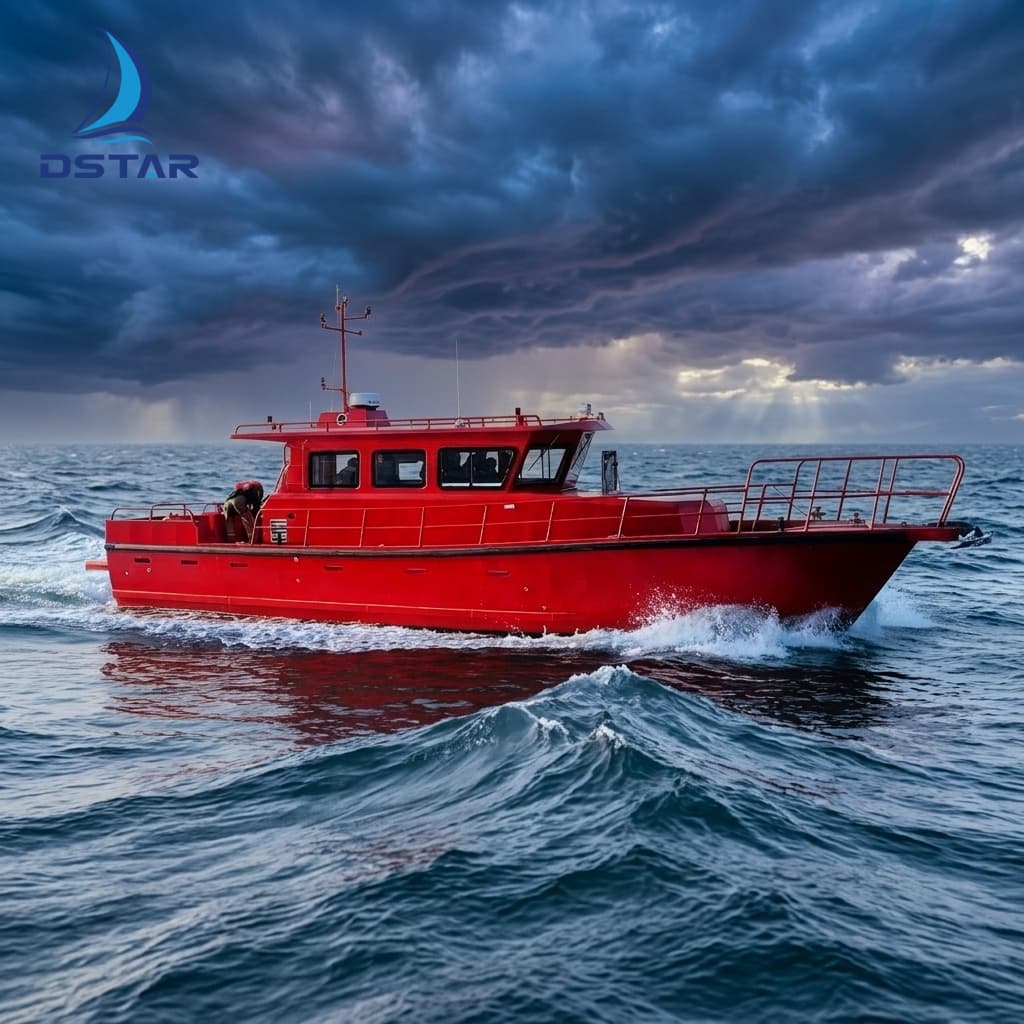
Unpredictable waters test a hull to its absolute limits. Submerged logs, rocky shallows, and harsh docking maneuvers happen daily. You need a material built specifically to absorb kinetic energy safely.
Fiberglass features a highly rigid, unyielding structure. This extreme rigidity creates a severe vulnerability during hard impacts. FRP is highly susceptible to spider-cracking and internal delamination. Striking submerged debris often leads to catastrophic hull breaches. Tactical boardings also risk structural shattering. FRP simply fractures when impact forces exceed its breaking point. Water intrusion happens almost instantly.
Conversely, marine aluminum boasts extremely high ductility. It physically bends before it ever breaks. An Aluminum Patrol Boat will dent rather than puncture under equivalent impact force. This crucial ductility allows missions to continue safely. Operators can return to port securely without taking on massive amounts of water. You can then schedule necessary repairs during routine maintenance windows.
Environmental degradation also separates these two materials significantly. Fiberglass remains uniquely prone to osmotic blistering. This chemical breakdown occurs if water penetrates a compromised external gelcoat. Furthermore, prolonged UV exposure steadily degrades FRP structural integrity over decades. Sun damage literally weakens the composite matrix over time, causing it to become brittle.
Aluminum acts entirely differently in harsh outdoor environments. It forms a natural oxide layer immediately upon air exposure. This microscopic layer naturally halts further surface oxidation. Marine alloys remain completely resistant to harmful UV rays. They also easily withstand extreme temperature fluctuations. Cold climates pose absolutely no freeze-thaw expansion risks. Ice impacts will not shatter an aluminum hull during winter patrols.
Fleet managers must prioritize practical field repairability. Commercial vessels inevitably suffer damage during demanding missions. How you fix them dictates your overall fleet availability.
Repairing fiberglass structural damage requires strict environmental parameters. You need a highly controlled, indoor environment. Technicians require specific temperature and humidity conditions for epoxy resin curing. Specialized labor is absolutely mandatory to match gelcoat finishes perfectly. This complexity forces vessels into expensive, specialized dry-dock facilities. You lose days or weeks of operational uptime.
Aluminum hulls offer massive logistical advantages for routine repairs. Technicians can often temporarily patch metal hulls quickly. They can also perform permanent TIG or MIG welding directly in the field. Austere docks serve perfectly well for these emergency fixes. A skilled welder can repair a hull breach overnight. This incredible flexibility drastically minimizes operational downtime.
Many buyers worry unnecessarily about saltwater corrosion. This common assumption requires immediate correction. Marine-grade aluminum performs exceptionally well in harsh saltwater environments. Operators simply must implement a strict preventative maintenance routine. You need to follow a rigid sacrificial anode replacement schedule. Properly maintaining zinc or aluminum alloy anodes completely prevents galvanic corrosion. You must also ensure electrical systems utilize proper galvanic isolators.
The upfront cost of a custom metal build is undoubtedly higher. However, you quickly offset this initial capital expense. Fleet operators see substantial financial savings within five to seven years. Reduced dry-dock time heavily boosts this long-term lifecycle value. Moreover, marine metal hulls frequently boast a reliable 30 to 40-year service life. They retain extremely high structural integrity long after composite hulls retire to the scrapyard.
Weight heavily influences maritime performance, payload capacity, and operational range. Aluminum provides a vastly superior weight-to-strength ratio. It remains significantly lighter than heavily laid fiberglass of equivalent strength. This crucial weight reduction translates directly into much shallower drafts. Shallow drafts are absolutely vital for riverine environments or coastal patrol duties. Lighter hulls also deliver faster acceleration. Furthermore, they provide noticeably lower daily fuel consumption.
Platform versatility highlights another major commercial engineering advantage. Aluminum fabrication does not require a fixed, expensive mold. Builders can easily cut and adapt metal plates for highly complex hull forms. This scalability makes metal heavily favored for specialized multi-hulls. For instance, builders frequently craft an Aluminum Catamaran Boat because it requires highly precise stability profiles. Scaling a specialized design into a high-capacity passenger ferry boat is equally seamless without massive re-tooling costs. You only pay for the custom engineering and the raw metal.
Post-production modifications are inevitable for long-term commercial fleets. Mission requirements change drastically over time. Adding heavy weaponry mounts is straightforward using standard welding techniques. You can easily attach specialized radar arches or extra reinforcement plating. You weld new components directly to the existing structural frames securely.
Fiberglass modifications remain notoriously complex and messy. Workers must grind down the protective gelcoat. They must add new fiberglass layers and carefully re-apply the exterior finish. This creates messy, time-consuming structural compromises. It also adds unnecessary weight to the vessel.
Agencies need a practical framework to finalize formal procurement requirements. You must align your material choice directly with daily operational realities. Let us break down exactly when to choose each material.
Choose Fiberglass If:
Your agency requires a massive fleet of identical, light-duty patrol craft.
Operations take place strictly in deep, debris-free open waters.
Upfront capital budget constraints absolutely override all long-term lifecycle considerations.
Crews rarely engage in vessel-to-vessel boarding operations.
Choose an Aluminum Patrol Boat If:
Vessels routinely operate in rocky coastal areas or extremely shallow rivers.
Your fleet navigates heavily congested, debris-heavy commercial ports.
Vessels face frequent physical contact during boarding operations or rough dockings.
Operational requirements demand a highly customized deck layout impossible for standard molds.
You require push-knees for maneuvering other vessels in tight harbors safely.
Your next steps involve conducting a comprehensive fleet analysis. You must factor in local field repair capabilities. Evaluate your expected daily mission hazards honestly. Set targeted fuel-efficiency metrics before releasing your formal Request for Proposal (RFP).
Below is a comparison chart summarizing key operational metrics to guide your strategy:
| Operational Metric | Fiberglass Composite (FRP) | Marine-Grade Aluminum (5000 Series) |
|---|---|---|
| Kinetic Impact Resistance | Rigid matrix; frequently fractures or shatters upon hard impact. | Highly ductile; yields and dents safely to prevent breaches. |
| Field Repairability | Poor; requires strict climate-controlled indoor facilities. | Excellent; allows rapid on-site field welding at austere docks. |
| Customization Potential | Very expensive; mandates new plug and expensive mold creation. | Highly flexible; utilizes direct plate fabrication and easy modification. |
| Expected Service Lifespan | 15 to 25 years (susceptible to gradual UV degradation). | 30 to 40+ years (protected naturally by self-healing oxide layer). |
| Weight-to-Strength Ratio | Heavy; requires thicker fiberglass layups for structural safety. | Lightweight; improves daily fuel efficiency and shallow water draft. |
Fiberglass remains a viable choice for standardized, light-duty marine applications. It serves mass-market recreational needs exceptionally well due to lower upfront costs. However, marine-grade aluminum clearly stands as the objective standard for heavy-duty patrol operations. Unpredictable environments demand materials engineered expressly for extreme resilience.
Agencies must prioritize mission readiness above all else. Structural survivability ensures your crews return home safely after dangerous deployments. Favorable lifecycle longevity makes custom metal fabrication the inherently superior, lower-risk investment. A severely dented aluminum hull keeps floating and fighting. A shattered composite hull simply sinks.
You should engage immediately with a certified marine architect to begin your procurement journey. Speak directly with a specialized commercial boat builder. They can help you spec the exact 5000-series alloy required for your jurisdiction. They will design a custom hull form perfectly matched to your distinct operational environment.
A: No, provided they are built correctly. Builders utilize marine-grade aluminum, specifically the 5000 series, which naturally resists oxidation. You simply must deploy a properly maintained sacrificial anode system. Replacing zinc or aluminum anodes on schedule completely prevents galvanic corrosion in harsh saltwater environments. Proper electrical isolation on shore power further protects the hull.
A: Both materials handle rough water effectively, but they perform differently. Heavy fiberglass boats naturally sit lower, dampening the ride slightly in heavy chop. However, aluminum boats can be precision-engineered to compensate entirely. Naval architects use specific deadrise angles, varied hull plating thickness, and strategic ballast systems to match fiberglass ride comfort while retaining unmatched structural superiority.
A: Initially, yes. Custom aluminum fabrication remains highly labor-intensive compared to pulling a fiberglass hull from an existing mass-production mold. However, analyzing a ten-year operational lifecycle almost always favors aluminum. Commercial operators experience drastically lower repair costs, significantly fewer dry-dock days, and a remarkably higher residual salvage value upon retirement.


