

Views: 0 Author: Site Editor Publish Time: 2026-10-06 Origin: Site


A 9–10 metre motor boat is the workhorse of coastal leisure: small enough to berth at a marina, big enough to carry a family or a group of guests across open water. But the difference between a boat that can do that safely and one that cannot often comes down to two things buyers overlook — its design category, and its engine configuration.
Every recreational craft is assigned a design category that defines the wind and wave conditions it is built for. In simple terms, the category tells you how far from shelter the boat is intended to operate. A boat designed and submitted for V-class approval is intended for coastal sea areas — exactly the environment most owners actually use: harbour approaches, island passages and near-shore cruising, where the water can turn rough quickly and there is no beach to run for.
This matters commercially as well as technically. Sightseeing operators, water-taxi services and charter businesses are usually required to demonstrate that the vessels they register meet the category appropriate to their route. A boat whose classification does not match the intended operation can end up restricted, re-surveyed or simply unusable. Choosing a design that already reflects coastal duty avoids that problem at the specification stage.
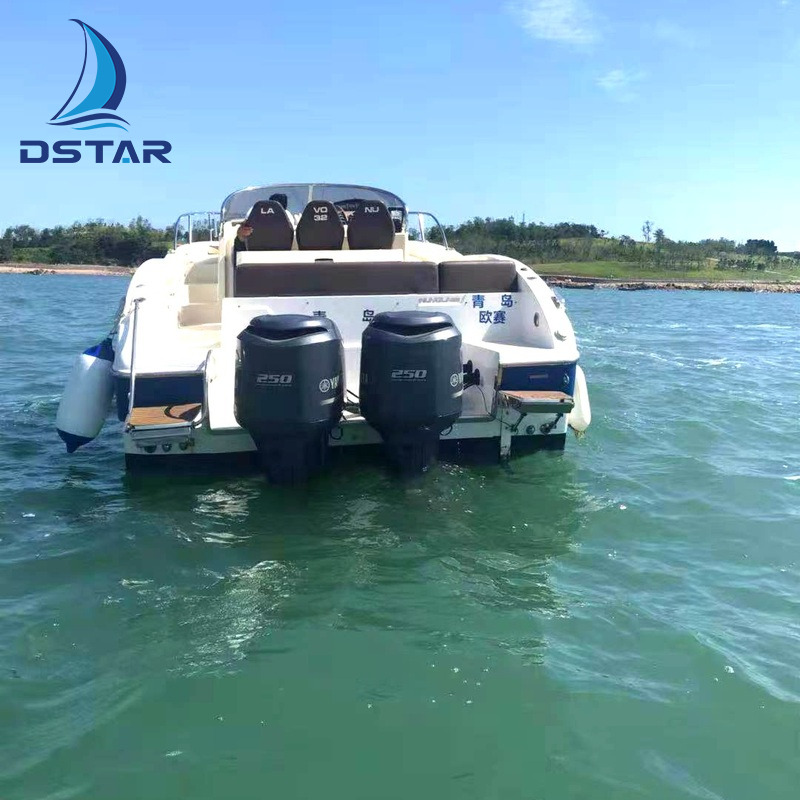
On a small planing boat, propulsion choice is really a question about risk. A single engine is lighter, cheaper and simpler — until it stops. Twin outboards change the arithmetic: with two 250HP motors on the transom, the boat has both the reserve power to stay on plane with a full load and, more importantly, the ability to limp home on one engine if the other fails. For anyone operating away from immediate assistance, that redundancy is worth more than the fuel it costs.
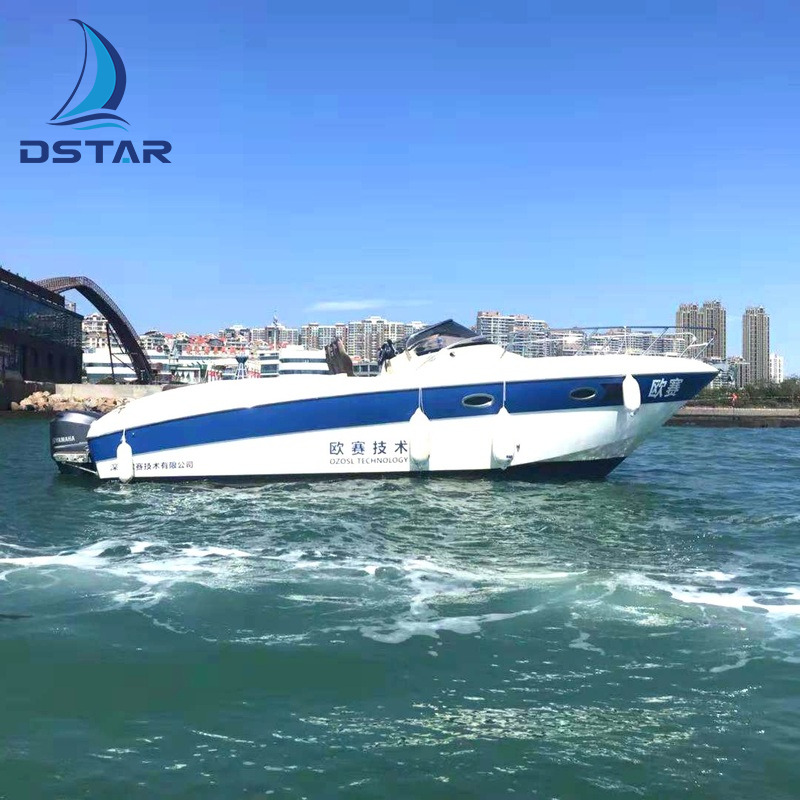
The new 32ft fiberglass coastal motor boat is a good example of the configuration working as a package: a 9.20 m moulded fiberglass hull, 3.00 m beam and 5.607 t full-load displacement, twin YAMAHA 250HP outboards, and a V-class coastal design — plus a cabin, marine toilet, fresh-water and sewage systems, and a full fit-out of anchor windlass, navigation lights, VHF and life-saving equipment as standard.
The hull material decision is less about fashion than about the job. Moulded fiberglass produces a smooth, low-maintenance finish, shapes that are efficient at planing speeds, and a hull that is straightforward to repair and refinish. Aluminum is stronger for its weight and more tolerant of contact with docks and debris, which is why it dominates workboats, patrol craft and catamaran ferries. For a coastal leisure or sightseeing boat running regular, relatively protected routes, fiberglass is usually the better economics; where the boat works cargo, patrol or rough-duty schedules, aluminum earns its premium. Our fiberglass range and aluminum boat range follow that split.
Buyers who get the most out of a boat of this size usually settle four things first: the design category needed for the route, the engine configuration and total horsepower, the seating and cabin arrangement for the number of passengers actually carried, and the safety and navigation equipment required by the local registry. Everything else — hull colours, interior finish, electronics and deck fittings — follows from those decisions, and all of it can be customised.
Qingdao Dookyu Crown Marine designs and builds fiberglass and aluminum motor boats, fireboats and passenger craft. Operators and owners are welcome to contact the shipyard with their route and passenger requirements, or browse the full news and product updates for more build stories.


