

Views: 0 Author: Site Editor Publish Time: 2026-09-05 Origin: Site


High-latitude navigation across the Arctic, Antarctic, and Northwest Passage historically favored heavy displacement monohulls. However, recent expedition trends show a distinct shift toward multihulls. Operating in polar regions presents a harsh reality. Vessels face constant ice collision risks, extreme sub-zero temperatures, massive payload requirements, and notoriously severe sea states. Surviving these conditions requires more than just standard offshore capability.
Our objective here is to objectively evaluate if an Aluminum Catamaran Boat is a viable, safe, and commercially sound choice for extreme latitude expeditions. We will move past theoretical marketing claims and dive straight into the structural realities. You will discover how material science, specific structural trade-offs, and rigorous winterization techniques determine polar success.
Aluminum’s high tensile strength and impact elasticity make it vastly superior to fiberglass (GRP) for glancing ice impacts and remote repairability.
Catamarans offer unparalleled platform stability and equipment payload capacity, critical for self-sufficient high-latitude expeditions.
Success hinges on managing aluminum's high thermal conductivity; improper insulation leads to severe condensation and heating inefficiencies.
For commercial operators, an aluminum passenger catamaran vessel provides superior ROI through increased guest capacity, reduced sea-sickness, and shallow-draft anchorage access.
Sailing into high latitudes presents unique baseline survival and performance criteria. You cannot rely on standard cruising metrics. Extreme latitudes demand specialized vessel capabilities. Expeditions routinely face isolation, freezing temperatures, and unpredictable weather windows. Navigating these waters safely requires a clear understanding of the environmental hazards.
Ice interaction is the primary operational concern. We must differentiate between managing growlers and navigating pack ice. Growlers and brash ice are loose chunks of glacial ice floating in the water. A well-built vessel can push through these manageable fields. Pack ice, however, forms a solid, freezing barrier. Surviving heavy pack ice requires specialized ice-class structural reinforcement. Standard recreational vessels should avoid pack ice entirely.
Self-sufficiency dictates your payload capacity. Polar regions lack marine infrastructure. You must carry massive fuel reserves to sustain operations. Provisions for extended periods are mandatory. Redundant heating systems add further weight. You must haul all these necessities without crippling the vessel’s sailing or motoring performance. Heavy payloads easily bog down poorly designed hulls.
Finally, we must address the most critical weather dynamic. Multihull stability in steep, high-latitude storm seas is the "elephant in the room." Southern Ocean storms generate massive, breaking swells. Surviving these seas requires active speed management. Skippers often deploy a series drogue from the stern. This slows the vessel and keeps it safely aligned with incoming waves.
Material choice dictates a vessel's lifespan in polar environments. Marine-grade alloys offer distinct advantages over traditional composites. When we examine extreme conditions, aluminum consistently outperforms fiberglass.
Impact Tolerance: Glancing blows against ice blocks are inevitable. Marine-grade aluminum, such as the 5083 alloy, handles these impacts brilliantly. The metal dents and deforms under high pressure. It absorbs the kinetic energy. Conversely, fiberglass (GRP) tends to fracture, shatter, or delaminate under similar forces.
Abrasion Resistance: Thin layers of surface ice constantly scour the hull along the waterline. This friction quickly grinds away gelcoat and exposes the fiberglass matrix beneath. Aluminum resists this constant abrasion. It maintains structural integrity even after weeks of surface scouring.
Remote Repairability: Damage happens during extreme expeditions. You can weld and patch an aluminum hull in remote commercial fishing ports worldwide. A local welder in Dutch Harbor or Ushuaia can fix a dented hull easily. Fiberglass repairs require specific, climate-controlled conditions. Resins will not cure properly in freezing polar air.
Water Ingress Protection: Safety requires compartmentalization. Builders easily engineer watertight crash bulkheads into aluminum hulls. They can also weld sacrificial bow sections. If an extreme impact breaches the bow, the primary hull remains completely sealed.
By leveraging these material strengths, an Aluminum Catamaran Boat provides exceptional durability. It turns potentially catastrophic impacts into manageable, repairable dents.
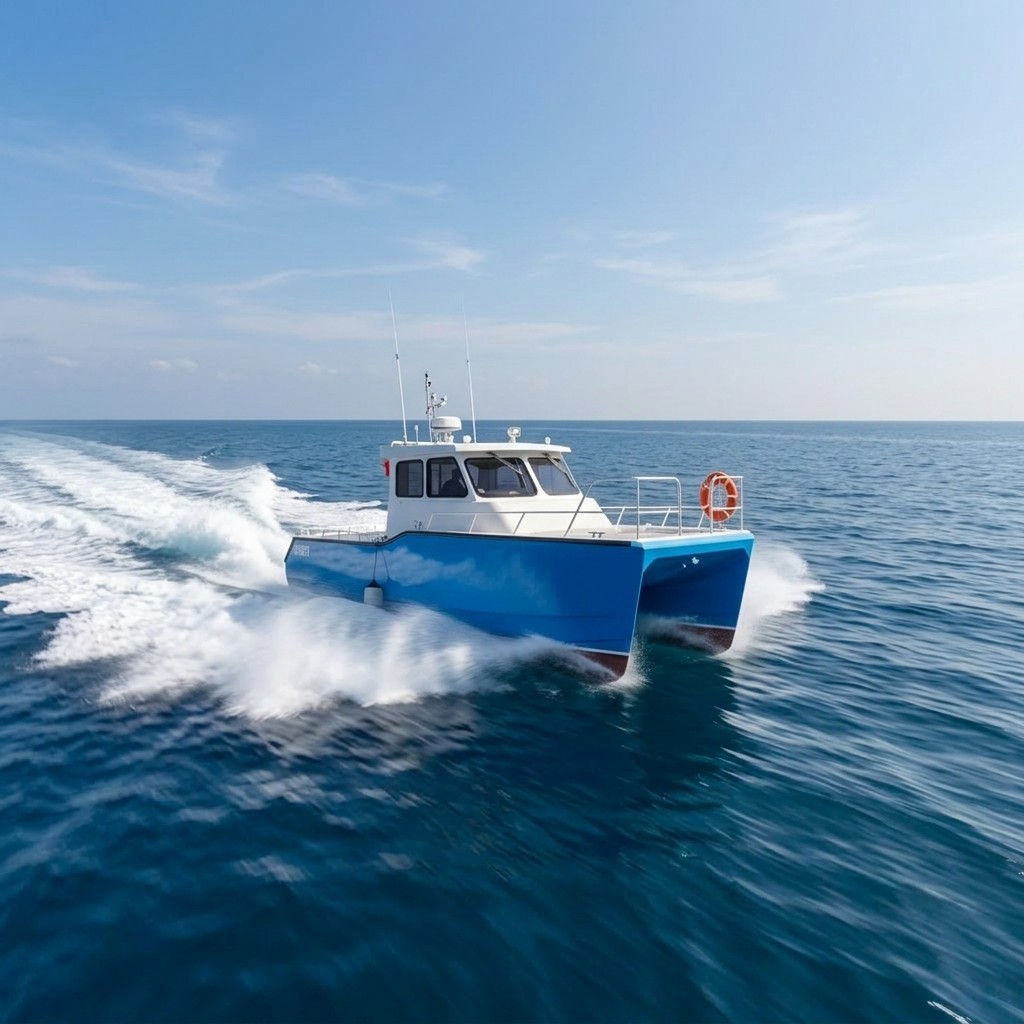
You cannot blindly take a tropical multihull design into the Arctic. The transition requires significant structural compromises. Builders must rethink the hull geometry to ensure survival.
Bridgedeck clearance is a critical design factor. The Southern Ocean produces massive, chaotic swells. If the bridgedeck sits too low, waves will slam into the underside of the vessel. This slamming creates violent shocks. It can damage structures and terrorize the crew. High-latitude catamarans demand exceptionally high bridgedeck clearance to allow waves to pass underneath safely.
Hull shape determines how the boat interacts with ice. Designers must choose between fine entry hulls and fuller bows. Fine hulls slice through waves efficiently. However, fuller bows offer more reserve buoyancy. We must acknowledge a vital risk here. Freezing pack ice exerts immense lateral pressure. Traditional rounded-hull monohulls naturally squeeze upward and pop out of the ice. Catamarans cannot do this. If pack ice traps a multihull, the crushing forces can destroy the hulls.
Windage management is another significant challenge. Catamarans feature wide beams and large cabin structures. High freeboards naturally increase the vessel's windage. When severe high-latitude gales strike, this large sail area makes the boat harder to control. Crews must aggressively reef sails early to manage stability.
Despite these challenges, multihulls offer a distinct draft advantage. Deep-keel monohulls require deep water. A catamaran can tuck into shallow, protected anchorages. You can navigate behind shallow glacial moraines to escape encroaching ice flows. This capability frequently saves expeditions from getting trapped in the ice.
| Structural Attribute | Aluminum Multihull | Traditional Monohull | Polar Impact |
|---|---|---|---|
| Draft Depth | Shallow (often under 1.5m) | Deep (often over 2.5m) | Multihulls can access shallow ice-free anchorages easily. |
| Ice Squeezing | Trapped laterally | Pushed upward safely | Multihulls must avoid heavy freezing pack ice completely. |
| Bridgedeck | Requires high clearance | Not applicable | Crucial for avoiding wave slamming in severe swells. |
| Windage | High (wide beam/cabin) | Moderate to Low | Multihulls face higher drift rates during severe gales. |
The expedition charter market relies heavily on profitability and guest experience. Shifting from monohulls to multihulls fundamentally changes the financial math. The commercial benefits are substantial.
A multihull platform maximizes both deck space and cabin volume. This scalability drives exceptional return on investment (ROI). Charter operators can carry more paying guests per foot of length overall (LOA). Scientific expeditions can house larger research crews. You gain expansive communal areas without needing a massive, fuel-hungry ship.
Passenger comfort directly influences commercial success. Platform stability is a key conversion metric for paying passengers. Crossing the infamous Drake Passage often induces severe seasickness in monohulls. A catamaran does not roll aggressively from side to side. It remains remarkably flat. This stability dramatically reduces passenger fatigue and illness. Happy guests leave better reviews and drive repeat business.
Expeditions require massive amounts of heavy equipment. Logistical storage is vastly superior on a multihull. The wide aft deck easily accommodates heavy rigid inflatable boats (RIBs). You can seamlessly store dive compressors, ROV equipment, and scientific gear. Storing this equipment across a wide beam keeps the vessel’s center of gravity low. It preserves the boat’s stability perfectly.
Deploying an aluminum passenger catamaran vessel requires strict compliance. Commercial operators must navigate international Polar Codes. Securing survey classifications for multihulls in ice-prone waters involves rigorous inspections. Marine authorities scrutinize structural integrity, safety redundancies, and environmental protections. However, once certified, these vessels command premium charter rates in the expedition market.
Building an aluminum hull is only the first step. You must aggressively winterize the vessel to survive extreme cold. Ignoring system vulnerabilities leads to catastrophic failures.
The thermal bridging threat is immense. Aluminum has extremely high thermal conductivity. It transfers freezing outside temperatures directly into the cabin. Without intervention, moisture from human breath and cooking instantly condenses on the cold metal. The interior will rain condensation and freeze solid. To prevent this, builders must apply continuous, closed-cell foam insulation. The insulation must cover all exposed metal down to the waterline to eliminate thermal bridges completely.
Seawater intakes pose a severe freezing risk. Standard thru-hull valves will freeze shut in sub-zero water. You lose engine cooling and watermaker feeds instantly.
To secure your systems, you must implement these critical winterization steps:
Install Internal Sea Chests: Replace standard thru-hulls with integrated sea chests built directly into the hull.
Add Heating Loops: Run dedicated heating pipes through the sea chests to prevent slush and ice blockages.
Insulate Plumbing: Wrap all internal freshwater and gray-water lines in heavy thermal jackets.
Upgrade Glazing: Install thick double-glazed or triple-glazed windows to stop heat loss through the cabin glass.
Heating redundancy is an absolute requirement. A single heater failure in Antarctica is a life-threatening emergency. You need robust, multi-zone hydronic heating systems. Brands like Kabola or Webasto circulate heated fluids through radiators. These units must be capable of continuous, uninterrupted operation in sub-zero ambient temperatures.
However, winterization creates weight penalties. Heavy insulation, double-glazed windows, and massive fluid-filled radiators add tons of displacement. This cascades into a performance issue. Heavy multihulls sail poorly and consume more fuel. Designers must carefully balance this added weight against the catamaran’s payload-to-displacement ratio.
Our evaluation yields a clear summary verdict. An aluminum catamaran is highly suitable for high-latitude sailing, provided it is explicitly designed for the environment. It requires high bridgedeck clearance, massive payload capacity, and rigorous thermal breaks. Conversely, it is entirely unsuitable if it is simply a standard tropical design constructed in metal.
Buyers and commercial operators must take actionable next steps before purchasing. You should audit the technical specifications rigorously. Check the alloy thickness, verify the closed-cell insulation details, and scrutinize the payload charts. Do not rely on standard production models disguised as polar explorers.
If you plan to navigate the world's most extreme waters, expert guidance is crucial. We encourage you to consult with specialized naval architects. Review detailed high-latitude vessel specifications thoroughly to ensure your platform meets the strict demands of polar survival.
A: No. They can push safely through loose growlers and light brash ice, but they are not icebreakers. Their hulls lack the weight and shape to crush thick ice. They rely heavily on speed, accurate weather routing, and shallow draft capabilities to avoid getting trapped in heavy pack ice entirely.
A: Not if insulated correctly. Without complete thermal breaks, yes, the metal hull acts like a giant refrigerator. However, with proper continuous closed-cell foam insulation and robust hydronic heating systems, the interior remains exceptionally dry, warm, and comfortable even in sub-zero conditions.
A: Yes, but with specific trade-offs. The heavy insulation works perfectly to keep the boat cool under the tropical sun. However, the high displacement resulting from heavy polar gear and reinforced hulls means it will sail much slower in light tropical winds compared to a dedicated performance multihull.


