

Views: 0 Author: Site Editor Publish Time: 2026-10-10 Origin: Site


Ask two shipyards which hull material is best and you will get two confident, contradictory answers. The honest answer is that steel, aluminum and fiberglass are each the right choice for a particular combination of size, duty and production volume — and the wrong choice outside it. Here is how the decision actually breaks down.
Steel dominates ferries and larger passenger vessels for reasons that are easiest to see at the build stage. A welded steel hull is stiff and robust, absorbs the repeated berthing, loading and grounding loads of commercial service, and can be cut and re-welded by any competent yard almost anywhere in the world. It also allows the long, boxy deck plans that give ferries their walk-on/walk-off access and generous passenger space, and it stays economical at lengths where aluminum and fibreglass stop making sense.
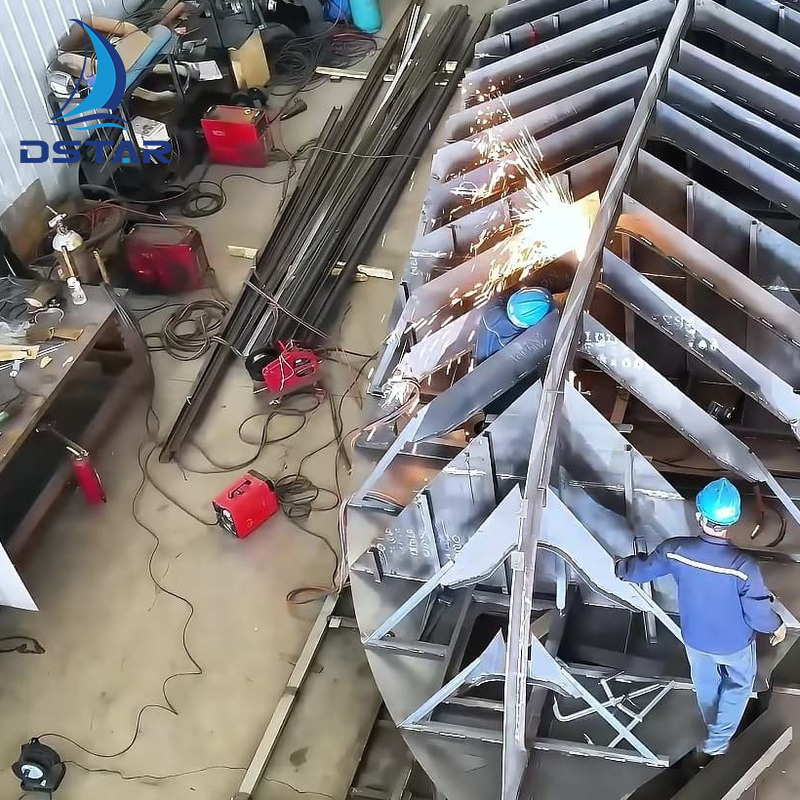
The trade-off is weight: a steel hull is heavier than an aluminum one of the same size, which costs speed and fuel. For a displacement passenger vessel running a scheduled route, that is a trade most operators accept deliberately. Our custom steel passenger vessel is built this way — frames erected and aligned on the jig, shell plating welded up, and the whole hull closed in under cover so that welding and coating are never at the mercy of the weather.
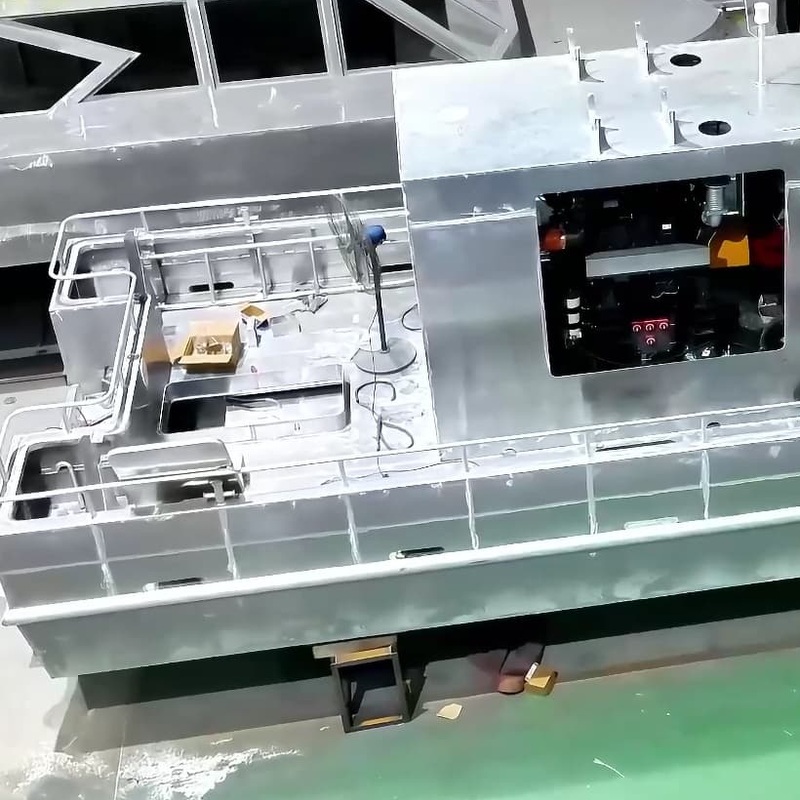
Aluminum is roughly a third the weight of steel for the same stiffness, which is why it dominates fast craft, workboats and patrol vessels. A lighter hull means higher speed for the same power, lower fuel burn, and — for a boat that has to be moved by road or lifted by crane — a weight that transport and lifting equipment can actually handle. It also resists corrosion without the extensive coating systems a steel hull needs, and it does not become brittle in cold water.
The premium is real, though. Aluminum costs more per kilogram, requires skilled TIG/MIG welders, and needs more care in design to avoid fatigue cracking at stress concentrations. For a barge or workboat that operates at displacement speed and is expected to be repositioned by road, it is usually the better economics. A good example is the 11.5m aluminum fire fighting barge, whose shallow 0.15–0.30 m draft and road-transportable weight come directly from the material choice.
Moulded fibreglass is the cheapest way to make many identical hulls. Once the mould exists, each additional hull is quick to lay up, needs no welding skill, and comes out with a smooth, low-maintenance finish that is straightforward to repair and refinish. That is why it owns the small and mid-size recreational market — where a builder expects to sell dozens or hundreds of the same model.
Outside that volume, the economics invert. A mould is expensive to make and only pays for itself across a series, so a one-off or a custom layout is wasteful in fibreglass. The material is also less tolerant of hard commercial duty and much harder to repair far from its builder. Our fibreglass range and the rest of the Dookyu Crown range follow that split: series boats in fibreglass, workboats and large passenger craft in aluminum and steel.
Four questions settle it in practice. How large is the vessel — is it beyond the size where aluminum and fibreglass remain economical? How heavy is the duty — will it be berthing against concrete and carrying cargo, or cruising? How will it be moved — does it have to travel by road or crane? And how many identical hulls will be built — one, or many? Steel answers size and hard duty; aluminum answers speed, weight and transportability; fibreglass answers series production.
If you are at the point of choosing, send us the route, the passenger or cargo requirement, the operating speed and how the vessel will be delivered. We will tell you which material the job actually calls for — and quote the build on that basis. More industry notes are in our news section.


