

Views: 0 Author: Site Editor Publish Time: 2026-06-26 Origin: Site


Offshore engineering projects operate on unforgiving margins. Equipment downtime and high operational costs can quickly derail strict timelines. You must select the right vessel material to manage both CapEx and OpEx effectively. Steel provides sheer raw mass but demands intense, ongoing maintenance. Conversely, fiberglass (FRP) offers sleek aesthetics but severely lacks impact durability in harsh marine conditions. An Aluminum Work Boat provides a specific weight-to-strength ratio you simply cannot ignore. It delivers the operational flexibility uniquely suited for surveying, crew transport, and offshore construction support. You only need to specify the right marine-grade alloy and demand robust manufacturing techniques. Read on to discover how modern vessel engineering balances rugged offshore durability with daily operational efficiency.
Heavy-gauge, all-welded aluminum work boats offer a superior strength-to-weight ratio, reducing fuel consumption while maximizing payload capacity.
Marine-grade alloys (specifically 5083 and 5086) provide exceptional natural corrosion resistance, drastically lowering lifecycle maintenance costs compared to steel.
Unlike fiberglass, aluminum deforms upon impact rather than fracturing, increasing crew safety in hazardous offshore environments.
Proper mitigation strategies—such as cathodic protection and deep-V hull designs—effectively eliminate historical objections regarding galvanic corrosion and rough ride quality.
Aluminum is approximately 30-40% lighter than steel of comparable strength. You can frame this as an immediate reduction in draft and propulsion requirements. A lighter vessel sits higher in the water. It encounters less hydrodynamic drag. Naval architects utilize this inherent material advantage to design hulls requiring significantly smaller engines. Smaller engines consume less fuel and require smaller fuel tanks. This compounding weight reduction makes an Aluminum Work Boat highly responsive. Operators can access shallower coastal shelves and maneuver tightly around massive offshore platforms.
Lighter hull weight translates directly into better fuel economy. You will notice this advantage heavily during long offshore transits. Less engine strain means lower daily fuel burn rates. Over a standard operational year, these fuel savings accumulate rapidly. They directly reduce daily OpEx. Many offshore project managers find fuel budgets stabilizing when they switch from heavy steel vessels. The predictable fuel economy allows procurement teams to forecast project budgets more accurately.
You can reallocate the saved vessel weight to crucial offshore engineering payloads. Every ton saved in hull construction equals another ton of available deck capacity. Project managers highly value this flexibility. You can optimize the vessel for varied missions without exceeding gross tonnage limits. Typical payload reallocations include:
Heavy surveying equipment: Multibeam echo sounders and heavy winch systems fit easily on the aft deck.
Remotely Operated Vehicles (ROVs): You can mount heavy launch and recovery systems safely.
Deck cranes: Hydraulic knuckles and telescopic cranes add vital lifting capabilities.
Additional personnel: You can expand crew cabin sizes to transport larger engineering teams comfortably.
Steel hulls require constant attention. You must budget for routine chipping, grinding, and repainting. Saltwater actively degrades exposed steel daily. Aluminum naturally forms an invisible oxide layer upon oxygen exposure. This layer acts as a permanent, self-healing shield against marine corrosion. You can eliminate the need for expensive marine paint systems entirely. A bare-aluminum or minimally painted work vessel offers outstanding long-term ROI. You drastically reduce dry-docking intervals. Maintenance crews spend less time fighting rust and more time servicing active machinery.
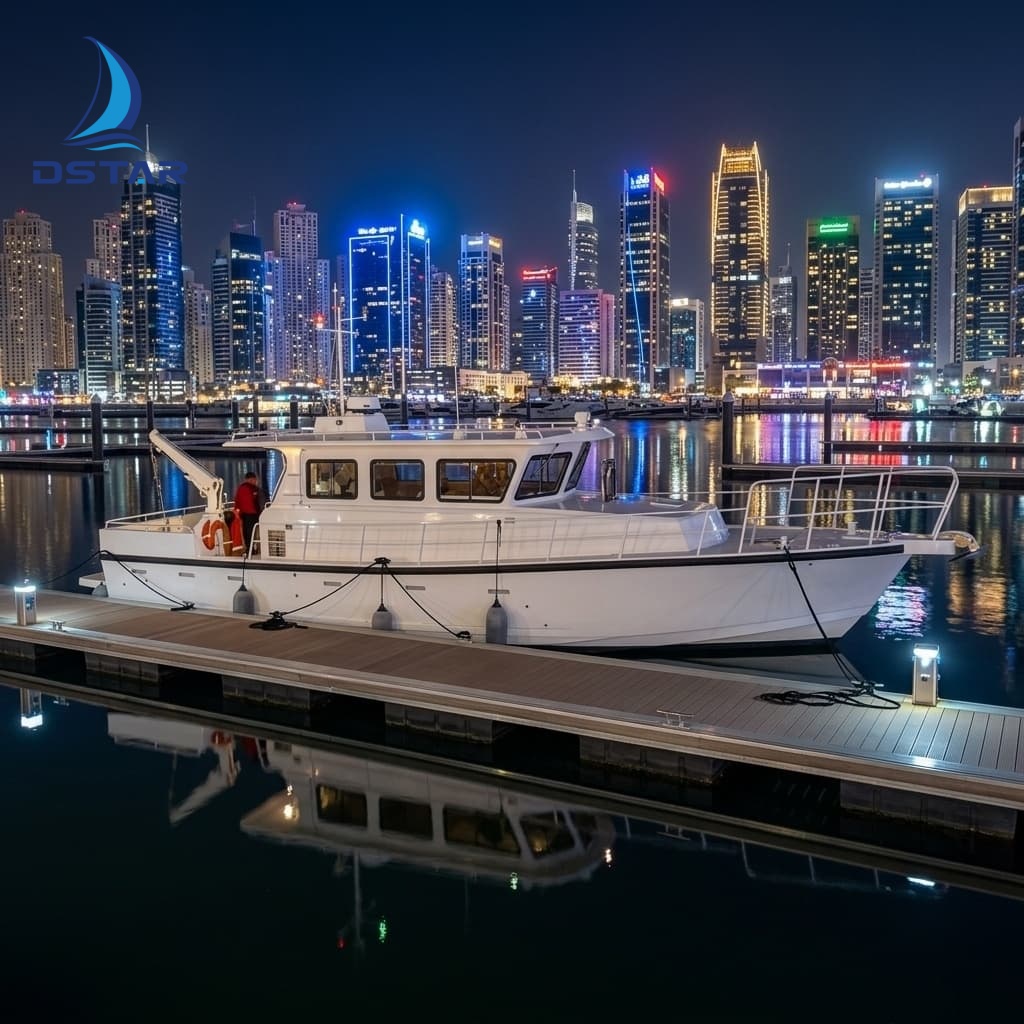
An aluminum hull absorbs kinetic energy completely differently than a fiberglass hull. In high-impact scenarios, aluminum yields and dents. It absorbs the shock of the blow. Fiberglass cracks, splinters, and shatters. This structural distinction becomes a life-saving feature in hazardous offshore environments. Consider common offshore hazards:
Striking submerged debris at high transit speeds.
Accidentally ramming unyielding steel pilings at offshore platforms.
Enduring aggressive bumping during pilot transfers in rough seas.
When an aluminum vessel strikes a log, the metal stretches. The hull retains watertight integrity. The crew remains safe, and the vessel limps back to port. A fiberglass vessel facing the same impact often suffers a catastrophic puncture. Water intrusion follows immediately. Offshore operators cannot risk structural fracturing when operating dozens of miles from the nearest safe harbor.
Offshore operations require strictly all-welded construction. Older or cheaper vessels sometimes utilize riveted aluminum panels. You must avoid these designs for serious offshore engineering work. Constant structural fatigue characterizes offshore chop. Waves batter the hull continuously. Over time, rivets stretch and loosen. The hull begins to weep water into the bilge. Continuous aluminum welding fuses individual plates into a single, monolithic structure. Welders melt the adjoining plates together, creating seams stronger than the parent material itself. This ensures absolute hull integrity over decades of service.
Commercial marine environments demand heavy-gauge materials. You must emphasize the necessity of heavy-gauge bottom plates. Commercial work vessels typically feature bottom plates 1/4 inch (6mm) or thicker. Side plates usually run 3/16 inch (5mm) or thicker. This robust thickness distinguishes true commercial work boats from consumer recreational vessels. Recreational boats often use thin sheets designed for calm lakes. Heavy-gauge aluminum resists tearing and puncture. It provides the rigid backbone necessary to support heavy diesel engines and massive deck loads.
You must actively warn buyers against consumer-grade alloys. Many inexpensive vessels use general-purpose aluminum alloys. These materials perform adequately in freshwater. However, saltwater rapidly pits and destroys them. Specifying the correct marine-grade alloy determines the lifespan of the entire vessel. Procurement teams must scrutinize material lists before signing build contracts.
Marine Alloy Specification Guide
| Alloy Series | Specific Grades | Primary Application | Key Characteristics |
|---|---|---|---|
| 5000 Series | 5083, 5086 | Hull plates, bulkheads, decks | Exceptional corrosion resistance, high tensile strength, highly weldable. |
| 6000 Series | 6061, 6063 | Extrusions, framing, stringers | Excellent formability, rigid structural support, good yield strength. |
| 3000 Series | 3003 | Interior non-structural trim | Consumer grade, not suitable for exterior saltwater exposure. |
Industry professionals identify 5083 and 5086 as the absolute standards for offshore marine construction. These specific alloys contain precise amounts of magnesium. The magnesium content provides high tensile strength and superior resistance to saltwater environments. Welders favor 5083 because it retains exceptional strength even after enduring extreme welding heat. When reviewing specifications for an Aluminum Work Boat, ensure the hull plating exclusively uses these two grades.
While 5000-series works perfectly for flat plates, builders need different materials for complex shapes. Builders utilize 6000-series aluminum, specifically 6061, for rigid structural extrusions. You will find 6061 used for T-bars, I-beams, longitudinal stringers, and complex framing. This alloy combines excellent formability with high yield strength. It provides the internal skeleton supporting the outer 5000-series skin.
Reputable builders refuse to buy uncertified metal. They source raw aluminum exclusively from certified mills. Good builders will provide full material certifications upon request. These documents trace every single alloy batch back to its origin. This traceability ensures compliance with major marine classification societies like ABS (American Bureau of Shipping) or DNV (Det Norske Veritas). Project managers must demand these certificates to guarantee structural seaworthiness.
You must address this common buyer hesitation transparently. Galvanic corrosion happens when two dissimilar metals touch in the presence of saltwater. It literally eats away the aluminum hull over time. However, modern marine builders effectively eliminate this risk. The solution relies on proper electrical isolation. Builders use non-conductive dielectric barriers between stainless steel fittings and the aluminum hull. They install premium marine-grade wiring using tinned copper. Furthermore, they strategically place sacrificial zinc or aluminum anodes along the submerged hull. These anodes actively attract the corrosive electrical current. They sacrifice themselves, fully protecting the expensive hull material.
Lighter vessels can theoretically lead to a harsher ride in offshore chop. A light boat naturally bounces over waves rather than plowing through them. You must acknowledge this physical reality. However, naval architects successfully mitigate this through aggressive deep-V hull designs. A sharp entry angle slices through incoming waves cleanly. Variable deadrise hulls flatten out toward the stern to provide extreme lateral stability. Additionally, modern builders install shock-mitigating suspension seating for the crew. These high-tech seats absorb heavy impacts, completely protecting the human spine during aggressive offshore transits.
Aluminum conducts both heat and sound exceptionally well. An uninsulated aluminum cabin sounds like the inside of a drum and bakes in the afternoon sun. Builders must outline strict requirements for commercial-grade acoustic damping. They spray thick acoustic damping paints directly onto the inner hull plates to kill vibration resonance. They install thick thermal insulation layers behind the cabin paneling. These mandatory steps meet occupational health and safety standards. They drastically reduce crew fatigue during long, demanding offshore shifts.
Offshore engineering remains a highly specialized field. Generic, off-the-shelf vessel designs rarely meet complex project demands. You must evaluate builders based on their ability to heavily customize deck layouts. Strong builders easily integrate heavy A-frames for towing equipment. They seamlessly incorporate hull moonpools for deploying advanced sonar arrays. They configure complex dive-support systems directly into the primary hull framework. They accomplish these extensive modifications without ever compromising the foundational structural integrity of the vessel.
A vessel's strength relies entirely on its weld quality. Look exclusively for builders employing certified welders. Reputable yards maintain active AWS (American Welding Society) or CWB (Canadian Welding Bureau) certifications. Their welders undergo rigorous, continuous testing. Furthermore, ensure the finished hulls comply with stringent ABYC, USCG, or equivalent international commercial standards. These credentials prove the builder possesses the deep expertise and proven experience necessary to construct safe offshore assets.
Procurement teams should never buy based solely on glossy brochures. You must request specific load-case analyses from the engineering department. Ask them to prove how the hull handles your specific payload requirements. Furthermore, always ask for reference projects. Request contact information for operators currently running their vessels in similar offshore sea states. Speaking directly with current captains provides the most trustworthy assessment of a builder's true capabilities.
An aluminum work boat is not just a standard vessel. It operates as a highly strategic asset balancing rugged offshore durability with daily operational efficiency. By leveraging the immense strength-to-weight advantages of marine-grade alloys, operators drastically reduce fuel consumption and optimize payload layouts. Furthermore, eliminating routine steel maintenance creates predictable long-term financial modeling.
Consider these final strategic takeaways:
Specify 5083 and 5086 heavy-gauge alloys for guaranteed saltwater longevity.
Demand all-welded construction to prevent structural weeping under high-fatigue sea states.
Ensure proper dielectric isolation and anode placement to neutralize galvanic corrosion risks.
Verify builder E-E-A-T credentials and demand certified commercial welders.
While massive steel ships may still dominate heavy transoceanic cargo shipping, aluminum stands out as the undisputed choice for fast, agile, and resilient offshore engineering support. We strongly encourage you to consult directly with a dedicated marine architect. Request a comprehensive technical consultation from a certified commercial boat builder. Discuss your specific project payload, desired sea state requirements, and long-term operational goals today.
A: With proper anode maintenance and baseline care, a commercial-grade aluminum hull can easily exceed 30 to 40 years of service life in harsh marine environments without structural degradation.
A: While specialized aluminum welding requires skilled labor, repairs are often faster and structurally stronger than fiberglass patches. Dents can often be left alone if they do not compromise the hull's hydrodynamics.
A: Yes. Specially reinforced heavy-gauge aluminum hulls (ice-classed) perform exceptionally well in icy conditions, as aluminum actually increases in yield strength and ductility at sub-zero temperatures, unlike some steels which become brittle.


