

Views: 0 Author: Site Editor Publish Time: 2026-09-30 Origin: Site


Offshore passages exact a heavy physical and psychological toll on any crew navigating unpredictable sea states. Hull design and material choice directly dictate vessel safety, motion comfort, and ultimate survival. Mariners face a persistent dilemma when planning extended voyages. You must balance the demand for high payload capacity and low maintenance against the absolute requirement for structural integrity. Motion comfort during multi-day ocean crossings remains non-negotiable.
Evaluating an Aluminum Catamaran Boat shifts the conversation from basic recreational sailing to expedition-grade offshore capability. The intersection of twin-hull geometry and metal construction creates a uniquely capable vessel. This combination eliminates the pendulum roll of traditional monohulls. It also provides a hull structure capable of absorbing massive kinetic energy. We will examine how this specific naval architecture delivers superior stability, impact resistance, and operational autonomy for serious offshore mariners.
Form Stability Over Weight Stability: Twin hull designs rely on beam width and buoyancy rather than heavy lead keels, drastically reducing roll amplitude in rough seas.
Unmatched Yield Strength: Marine-grade aluminum absorbs kinetic energy through deformation rather than shattering, providing critical impact resistance against floating debris.
Optimized Center of Gravity: The high strength-to-weight ratio of aluminum allows for a lighter superstructure, keeping the center of gravity low and further enhancing stable ocean cruising.
Remote Repairability: Unlike composite hulls that require climate-controlled environments and specific resins, an aluminum hull can be repaired by competent welders in remote global ports.
Maintenance and Longevity: While requiring strict electrical system management to prevent galvanic corrosion, unpainted aluminum hulls offer decades of structural reliability and exceptional resale value with minimal cosmetic upkeep.
Establishing clear metrics for a comfortable sea state is the first step in evaluating vessel performance. Success criteria for offshore motion include reduced roll amplitude, minimized pitching moments, and highly predictable righting forces. Crew fatigue directly correlates to the constant physical exertion required to maintain balance. Minimizing deck motion preserves crew energy, sharpens decision-making, and enhances overall vessel safety during extended watches.
Traditional monohulls rely heavily on weight stability. Naval architects place a massive lead or iron keel deep underwater. This heavy appendage acts as a counterweight to the wind pressing against the sails. When a wave or wind gust pushes the boat over, gravity pulls the keel down. This creates a pendulum effect. The boat constantly rolls back and forth around its center of gravity. This pendulum motion generates significant crew fatigue during long passages and makes simple tasks like cooking or navigating physically exhausting.
A twin hull boat utilizes form stability instead. The distance between the two buoyant hulls provides massive resistance to heeling forces. When wind or waves apply lateral pressure, the leeward hull depresses slightly into the water. Its inherent buoyancy pushes back immediately. This wide stance eliminates the need for a heavy ballast keel. The vessel remains upright and level, tracking cleanly through the water without the exhausting pendulum roll.
The wide stance of a multihull prevents the violent snap-roll common in deep-keeled vessels. Roll amplitude refers to how far a boat tips from side to side. Monohulls often roll thirty degrees or more in steep seas. Multihulls typically limit roll to less than ten degrees. This dramatic reduction in roll amplitude transforms the onboard experience. You can move around the cabin, sleep soundly, and manage navigation equipment without fighting gravity. It drastically reduces the risk of seasickness during multi-day passages.
Pitching refers to the bow-to-stern seesaw motion over waves. Twin hulls slice through the water independently. Fine bow entries pierce waves rather than riding over them. This reduces the upward pitching moment. The long waterline length relative to the narrow beam of each individual hull further dampens pitch. The result is a smoother, more linear ride through chaotic offshore wave patterns, preventing the bow from launching off wave crests and slamming into the troughs.
The nacelle and bridge deck connect the two hulls. Engineering this central structure requires precise calculations. Bridge deck clearance is the vertical distance between the resting waterline and the underside of the central deck. High clearance is absolutely critical for offshore safety and structural longevity.
Low bridge decks suffer from severe wave slamming. When waves pass between the hulls, they can strike the underside of the deck. This creates violent shocks, deafening noise, and massive structural stress on the bulkheads. Adequate bridge deck height allows waves to pass cleanly underneath. A well-designed nacelle breaks up rogue waves before they impact the flat surfaces. Maintaining high clearance prevents wave slamming, ensuring structural integrity in chaotic offshore conditions and keeping the crew comfortable below decks.
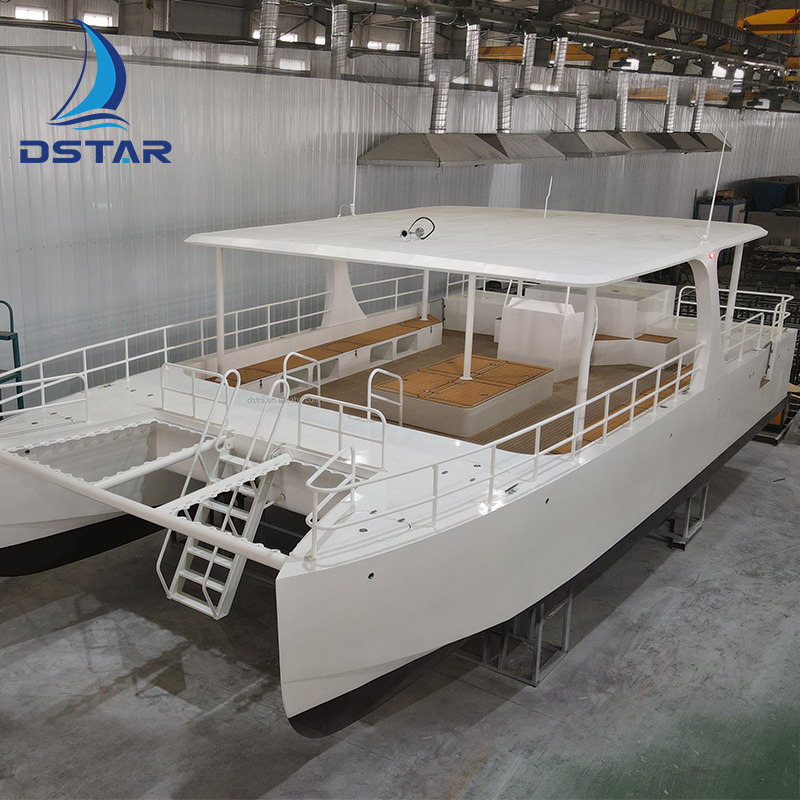
Hull material dictates how a vessel responds to extreme stress, impacts, and environmental degradation. Fiberglass dominates the recreational market due to cheap mass production. However, expedition sailing demands entirely different material properties. Metal construction offers distinct advantages for mariners heading into remote, unforgiving environments where self-reliance is mandatory.
Builders construct a true marine grade aluminum boat using specific 5000-series alloys. Naval architects primarily specify 5083 and 5086 aluminum for hull plating. These alloys contain magnesium, which provides exceptional strength and superior corrosion resistance in saltwater environments. We strictly avoid 6000-series alloys for hull plating because they degrade rapidly when continuously submerged in seawater.
Aluminum possesses a unique chemical defense mechanism. When exposed to oxygen, bare aluminum instantly forms a microscopic layer of aluminum oxide. This hard, transparent layer seals the underlying metal from further oxidation. If you scratch the hull against a dock, the oxide layer instantly reforms. This self-healing protective barrier acts as a permanent shield against environmental corrosion. It eliminates the need for cosmetic topside paint, drastically reducing exterior maintenance and allowing you to focus on sailing rather than polishing gelcoat.
Weight management is critical in multihull design. Heavy catamarans sit low in the water, increasing drag and reducing bridge deck clearance. Aluminum offers a phenomenal strength-to-weight ratio. It is significantly lighter than steel and often lighter than solid fiberglass layups used in production boats.
Saving weight in the hull plating and deck structures allows naval architects to optimize weight distribution. Builders can lower the vessel's center of gravity by keeping the superstructure light. A lower center of gravity directly contributes to stable ocean cruising. It increases the righting moment and reduces pitching inertia. The vessel recovers faster from wave impacts, maintains higher average speeds under sail, and handles heavy weather with greater predictability.
Ocean debris poses a severe threat to offshore sailors. Submerged shipping containers, floating logs, and uncharted reefs can destroy a vessel in seconds. The modulus of elasticity defines how a material responds to kinetic energy. Fiberglass is brittle. Upon severe impact, it fractures, shatters, and delaminates. Water immediately breaches the hull, leading to catastrophic flooding.
Aluminum absorbs massive kinetic energy through plastic deformation. If you strike a submerged shipping container at eight knots, an aluminum hull will dent. The metal stretches and yields, but it rarely tears or punctures. This ductility provides a massive safety margin. Denting rather than fracturing keeps the ocean on the outside. This impact survivability is the primary reason high-latitude expedition sailors, who frequently navigate ice-filled waters, choose metal hulls.
Structural damage in remote locations presents a nightmare scenario for composite boat owners. Repairing fiberglass requires specific ambient temperatures, low humidity, and specialized two-part epoxy resins. You cannot properly cure fiberglass in a wet, freezing Patagonian anchorage or a humid tropical lagoon.
Aluminum offers unmatched remote repairability. If you sustain structural damage in an isolated atoll or high-latitude port, repair is straightforward. Standard TIG or MIG welding equipment is ubiquitous globally. Almost every commercial fishing port or industrial harbor has competent metalworkers. A local welder can cut out a damaged plate and weld in a new one within hours. This facilitates permanent, full-strength repairs without complex curing requirements or climate-controlled sheds, getting you back underway safely.
Understanding how physical design features translate into operational outcomes helps buyers make informed decisions. An offshore catamaran must do more than just float; it must serve as an autonomous, secure base of operations for months at a time, carrying everything required to sustain the crew.
Extended cruising requires massive amounts of stores, spares, and equipment. The inherent buoyancy of twin hulls, combined with a lightweight metal structure, maximizes available payload capacity. You can load the vessel heavily with ground tackle, redundant autopilots, and extensive tool kits without sinking the transoms below the waterline.
High payload capacity directly translates to cruising autonomy. You can carry heavier, high-output watermakers. You can install massive lithium battery banks and extensive solar arrays to run induction cooktops and air conditioning off-grid. You can provision for six months of isolated cruising. The vessel absorbs this weight without compromising its designed waterline, bridge deck clearance, or sailing stability.
Deep-keel monohulls often draw seven to ten feet of water. This restricts their access to many protected anchorages, coral atolls, and inland waterways. Multihulls typically feature a very shallow draft, often under four feet, utilizing daggerboards or shallow mini-keels for lateral resistance.
This shallow draft provides a massive operational advantage. You can navigate over shallow reef passes to access protected lagoons. You can tuck deep into hurricane-hole anchorages to escape severe weather. Furthermore, metal hulls can be safely beached. You can intentionally run the boat onto a sandy shore during high tide. When the tide recedes, the boat sits level on its reinforced keels. This allows you to perform bottom maintenance, clear fouled props, or inspect through-hulls without paying for a travel lift.
The ocean applies massive twisting forces to a multihull. As the port bow climbs a wave while the starboard stern drops into a trough, the entire structure wants to twist. The bridge deck connecting the two hulls must resist this torsional stress to prevent the boat from tearing itself apart.
Welded aluminum provides superior structural stiffness compared to bolted or bonded composite bulkheads. A metal catamaran is essentially a single, continuous monocoque structure. The crossbeams, bulkheads, and hull plating are fused together at a molecular level via welding. This prevents twisting and flexing in chaotic sea states. The rigid platform eliminates the creaking and groaning often heard in composite boats, ensuring long-term structural integrity and a quiet ride.
| Material Feature | Marine Grade Aluminum | Production Fiberglass (FRP) | Marine Steel |
|---|---|---|---|
| Impact Resistance | Excellent (Dents and yields) | Poor (Fractures and delaminates) | Outstanding (Extremely hard to puncture) |
| Weight-to-Strength | High (Lightweight, strong) | Moderate (Requires thick layups) | Low (Very heavy) |
| Remote Repairability | High (Standard TIG/MIG welding) | Low (Requires climate control/resins) | High (Basic stick welding) |
| Torsional Stiffness | Superior (Fully welded monocoque) | Moderate (Bonded bulkheads can flex) | Superior (Fully welded) |
| Maintenance Focus | Galvanic isolation, anode replacement | Waxing, gelcoat repair, osmosis prevention | Continuous rust prevention, heavy painting |
No vessel design is perfect. Choosing metal construction introduces specific operational realities. You must understand and mitigate these trade-offs to ensure the longevity and comfort of your vessel. Ignoring these realities will lead to rapid hull degradation and an uncomfortable living environment.
The primary risk of owning a metal vessel is electrolysis and galvanic corrosion. When dissimilar metals interact in saltwater, a mild electrical current flows between them. The less noble metal sacrifices itself to protect the more noble metal. Stray electrical currents from poorly wired marinas can also rapidly dissolve hull plating.
Strict mitigation strategies are mandatory. Implementing a robust defense against galvanic corrosion requires a systematic approach:
Install a marine-grade isolation transformer to sever the direct electrical connection between the shore power grid and the boat.
Wire the entire vessel using an ungrounded DC system, commonly known as a two-wire system.
Ensure the hull never serves as a ground return path for any electrical circuits.
Mount sacrificial zinc or aluminum anodes directly to the hull and inspect them monthly.
Isolate all stainless steel fittings from the aluminum plating using dielectric barriers like Delrin washers or Tef-Gel.
Aluminum conducts heat and sound exceptionally well. Without proper insulation, a metal boat will be freezing in high latitudes and boiling in the tropics. Furthermore, cold ocean water against bare metal creates severe interior condensation. Bare metal hulls also amplify the sound of water slapping against the chines, making it difficult to sleep in choppy anchorages.
You must address these thermal and acoustic realities during the build process. Builders apply closed-cell foam insulation directly to the interior hull plating above the waterline. Armaflex sheets or professionally applied spray foam create a continuous thermal break. This insulation prevents warm, moist interior air from contacting cold hull plating, entirely eliminating condensation. The foam also acts as a highly effective acoustic dampener, deadening hull slap noise and creating a quiet, comfortable interior environment.
Commissioning or purchasing an aluminum catamaran requires careful evaluation of builders, designs, and certifications. The metal boatbuilding industry operates differently than mass-production fiberglass factories. You must verify the engineering pedigree and construction standards before committing to a build.
Buyers typically choose between full custom naval architecture and semi-custom platforms. A full custom build offers absolute flexibility. You work directly with a naval architect to design every frame, bulkhead, and cabin layout from scratch. This process requires significant time for engineering, weight calculations, and tank testing.
Modifying an existing semi-custom hull platform offers a more streamlined approach. The builder uses a proven, pre-engineered hull shape. You then customize the interior layout, deck hardware, and sail plan. This drastically reduces engineering timelines while still delivering a highly personalized, expedition-ready vessel based on a proven hydrodynamic foundation.
Verify the builder's credentials before signing any contracts. The vessel should meet or exceed CE Category A Ocean certification requirements. This certification dictates strict standards for stability, buoyancy, and structural integrity in extreme offshore conditions.
Electrical systems must strictly comply with ABYC standards, specifically regarding two-wire ungrounded systems for metal hulls. Furthermore, the shipyard must adhere to ISO welding standards. Inspect the hull for continuous, uniform TIG or MIG welds. High-quality welding ensures the structural monocoque remains intact under severe torsional loads. Look for clean, even weld beads without porosity or undercut.
Never purchase a vessel without a rigorous sea trial and a professional survey. Hire a marine surveyor specifically certified in metal hulls. They will conduct ultrasound thickness testing to verify plate integrity and check for hidden galvanic corrosion. They may also use dye penetrant testing on critical structural welds to identify microscopic stress fractures.
During the sea trial, evaluate specific offshore metrics. Drive the boat into choppy head seas to assess bridge deck clearance. Listen for wave slamming under the nacelle. Test the vessel's behavior in quartering seas to ensure the bows do not bury aggressively. Finally, inspect the accessibility of all electrical chases and plumbing runs. A well-designed expedition boat provides immediate access to critical systems for underway maintenance.
Consult with a specialized naval architect to determine if a semi-custom or full custom build best suits your expedition timeline.
Schedule a tour of an established aluminum boatyard to inspect continuous welding techniques and closed-cell insulation applications firsthand.
Hire an independent marine surveyor certified in metal hull ultrasound testing before making any offers on brokerage vessels.
Draft a strict electrical schematic plan focusing on isolation transformers and ungrounded DC systems to ensure long-term hull integrity.
A: Yes, they are exceptionally safe. An aluminum hull acts as a perfect Faraday cage. When lightning strikes the mast, the electrical energy travels down the rigging and disperses instantly and safely through the highly conductive metal hull into the surrounding ocean. This protects the crew and internal electronics much better than composite hulls.
A: Twin hulls eliminate severe heeling, keeping the deck level. They excel at surfing down large waves safely due to their buoyancy. However, they lack the ultimate self-righting capability of a deep-keel monohull. Therefore, active speed management and proper sail reduction are critical to prevent pitchpoling in extreme conditions.
A: Yes, below the waterline. While the aluminum won't rust, marine organisms like barnacles and algae will still attach to the bare metal. You must use specialized, copper-free antifouling paint. Applying traditional copper-based paint to an aluminum hull will cause catastrophic galvanic corrosion.
A: With proper electrical maintenance and rigorous corrosion prevention, the hull can easily last 50 years or more. The 5000-series marine alloys do not degrade, fatigue, or absorb water like fiberglass. As long as stray electrical currents are mitigated, the structural lifespan is virtually unlimited.
A: A well-designed aluminum catamaran is typically lighter than a solid fiberglass hull and comparable in weight to cored composite vessels. Aluminum provides a superior strength-to-weight ratio, allowing builders to achieve massive impact resistance without adding excessive weight to the vessel.
A: Prevention relies on strict electrical isolation. You must use an isolation transformer for shore power, wire the boat with an ungrounded two-wire DC system, install proper sacrificial anodes, and use dielectric barriers like Delrin washers to physically separate dissimilar metals from the aluminum hull.
A: Yes. Unlike fiberglass, which requires specific temperatures, low humidity, and specialized resins to cure properly, aluminum can be repaired almost anywhere. Commercial metalworkers in remote fishing ports or industrial harbors can easily cut and weld aluminum plates using standard TIG or MIG equipment.


